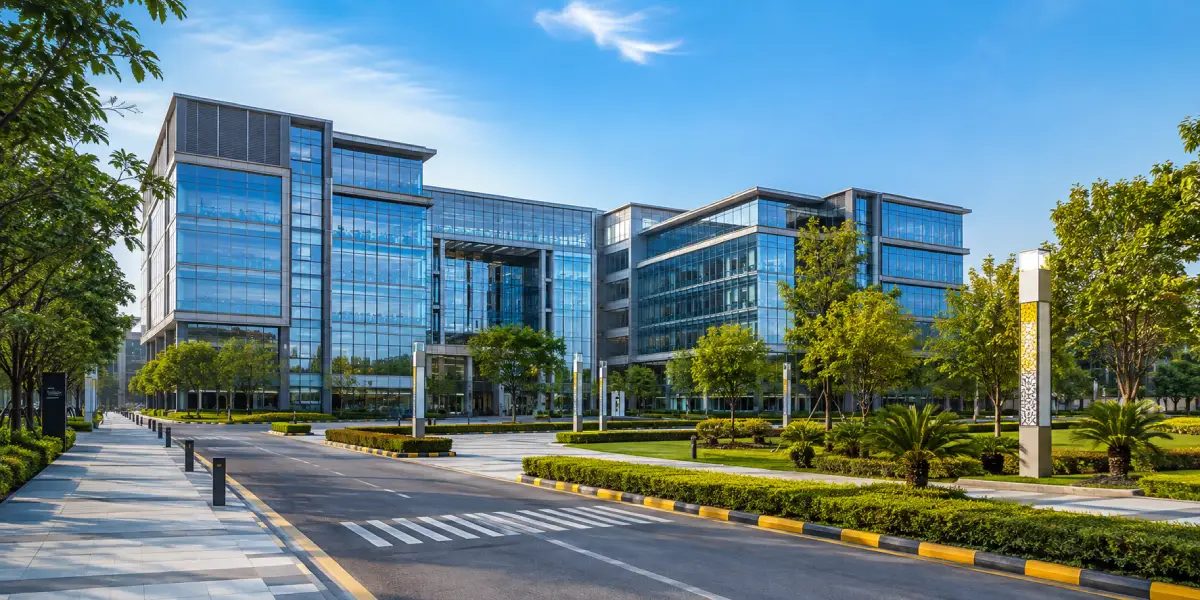
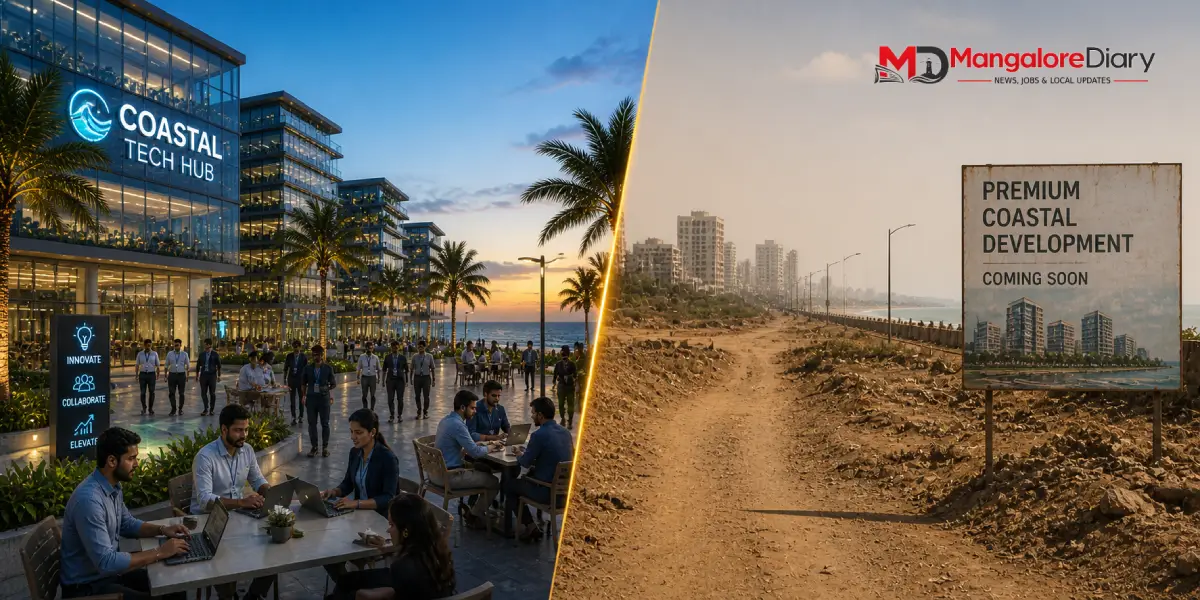
The Union Finance Minister named Mangaluru by name at a national summit. Karnataka's own state policy lists it as a priority "Beyond Bengaluru" city with real financial incentives attached. Here's what a Global Capability Centre actually is, why the timing might genuinely favour Mangaluru, and what's realistic to expect over the next five years — first in our new series on industries that could grow in the city.
What a GCC Actually Is, in Plain Terms
A Global Capability Centre is a company's own in-house delivery centre set up in a country like India — not an outsourced vendor, but a captive unit fully owned and operated by the global parent company itself. A multinational bank, insurer, retailer or manufacturer sets one up to run functions like finance and accounting, human resources operations, supply chain and procurement, software engineering, R&D, data analytics, and increasingly AI and automation work, directly for its own global operations rather than farming that work out to a third-party outsourcing firm.
This is a genuinely large and fast-growing part of India's economy. The country currently hosts more than 1,700 GCCs, employing close to 1.9 million professionals and generating over $64–65 billion in annual revenue, according to industry estimates cited across multiple 2025–2026 reports. Real estate services firm JLL reported that GCC office leasing hit a record 31 million square feet in 2025, and the sector is projected to grow at more than 10% annually through 2030, with the total number of centres expected to reach 2,100–2,400 by then.
Why This Sector, and Why Now
Two very current, very specific developments make this the right moment to look at GCCs as a Mangaluru opportunity rather than a distant possibility.
First: Union Finance Minister Nirmala Sitharaman named Mangaluru directly, in a public national address. Speaking at the Mindmine Summit in Delhi in June 2026, she said, describing how GCC investment has moved beyond the traditional metros: "Earlier, it used to be just Bengaluru, probably Hyderabad, Noida or Ghaziabad... Now you have cities like Tumkur and Mangaluru." That is about as direct a national-level policy signal as a mid-sized coastal city is likely to get.
Second, and more concretely: the Karnataka GCC Policy 2024–29, finalised on 19 November 2024 at the Bengaluru Tech Summit, explicitly names Mangaluru — alongside Mysuru, Hubballi-Dharwad-Belagavi, Kalaburagi, Tumakuru and Shivamogga — as a target city under its "Beyond Bengaluru" initiative. This is not vague aspiration; the policy attaches real, quantified financial incentives for GCCs that set up in these cities:
- Rental reimbursement of up to 50% of costs, capped at ₹2 crore, for the first year of operations
- R&D infrastructure assistance of up to 40% of costs, or ₹50 crore, for up to two GCCs per year
- EPF contribution reimbursement of ₹3,000 per employee per month, for two years
- 25% reimbursement of telecom costs, for three years
- Access to a dedicated Beyond Bengaluru Cluster Seed Fund and a ₹100 crore innovation fund for GCC-academia collaboration
The state's overall target under this policy is 500 new GCCs, roughly 3.5 lakh new jobs, and $50 billion in added economic output by 2029 — Mangaluru is one of a handful of cities named as a beneficiary location for that push, not the primary target, but a named one nonetheless.
What Mangaluru Specifically Brings to the Table
Beyond the policy tailwind, a few things about Mangaluru's existing profile plausibly make it a genuine candidate rather than just a name on a list:
A surprisingly strong employability ranking. According to the India Skills Report 2023, cited by EY in its own research on GCC expansion into Tier-2 cities, Mangalore ranked among the top three most employable cities in India — a genuinely specific, favourable data point that goes beyond generic "growing talent pool" language.
An existing, if modest, IT base to build on. As we covered in our earlier feature on career opportunities in Mangalore, the city already hosts Cognizant's largest local MNC IT presence, a growing Mphasis operation, and a small but real home-grown tech sector (Robosoft Technologies, Invenger Technologies, and others). A new GCC rarely arrives in a city with zero existing technology-sector infrastructure; Mangaluru already clears that baseline.
A genuine engineering talent pipeline. NITK Surathkal, one of India's National Institutes of Technology, sits within the district, alongside several other engineering colleges — directly relevant given that over 60% of India's engineering graduates now come from Tier-2 and Tier-3 cities nationally, a trend industry reports point to as central to the entire Tier-2 GCC shift.
Sector-specific specialisations worth naming. Given Mangaluru's unusually deep healthcare and medical-education base (seven-plus medical colleges, major teaching hospitals, covered in detail in our earlier feature on why Mangalore became a medical hub) and its historic banking legacy (Karnataka Bank remains headquartered locally, as we covered in our careers feature), the city arguably has a more specific, differentiated pitch to make than a generic "cheaper than Bengaluru" argument — a health-tech or BFSI-support-focused GCC pitch would have real local expertise to point to, not just cost savings.
Available commercial real estate capacity. Our earlier feature on Mangaluru's established builders documented an active local construction industry with a genuine track record of commercial development. Office-space availability is one of the four core factors GCC location-strategy consultants say enterprises evaluate before choosing a city, alongside talent, cost, and infrastructure.
What Kind of Work Would Actually Come First
It is worth setting realistic expectations rather than implying Mangaluru is about to host a strategic AI research lab. Industry reports on Tier-2 GCC expansion are fairly consistent that the functions which move to newer, smaller GCC locations first are generally the more standardised, process-driven ones — finance and accounting, HR operations, supply chain and procurement, quality and engineering support, and digital/cloud operations — rather than a company's most strategic, headquarters-adjacent R&D mandates, which tend to stay concentrated in the largest, most established hubs (Bengaluru alone still commands 34–39% of India's total GCC activity, with more than 900 units). A realistic five-year outlook for Mangaluru is a small but growing number of GCC support-services units — likely in finance, HR shared services, and possibly health-tech- or BFSI-adjacent support functions given the city's specific strengths — not a wholesale relocation of high-end R&D from the metros.
What We Could Not Verify — And Want to Be Direct About
In researching this piece, we looked specifically for evidence of named global companies that have already opened dedicated GCC operations in Mangaluru itself, as opposed to the city being mentioned as a policy target or a talent-pool candidate. We did not find confirmed, named examples of established GCCs currently operating in Mangaluru at the scale seen in comparison cities like Coimbatore (Bosch Global Software Technologies, 5,000+ employees) or Thiruvananthapuram (Nissan Digital, Allianz Services). This does not mean none exist — our research window and available sources may simply not have captured smaller or more recent announcements — but we think it is important to be honest that what currently exists for Mangaluru is a strong policy tailwind and a favourable talent profile, not yet a documented track record of major GCC operations already up and running. That distinction is exactly why this piece is framed as "could grow," not "is growing."
The Takeaway
Mangaluru's case for GCC support-services growth rests on unusually concrete ground for a "could grow" story: a specific, named mention from the Union Finance Minister, a state policy with quantified financial incentives naming the city directly, a top-three national employability ranking, and existing sector strengths in healthcare and banking that could support more specialised GCC pitches than cost alone. What it does not yet have, as far as our research could establish, is a visible track record of major named GCCs already operating at scale in the city the way some comparable Tier-2 cities do. The next five years will show whether Mangaluru converts that policy tailwind into the kind of concrete, named GCC investments Coimbatore and Thiruvananthapuram can already point to — or whether the city remains a name on a policy list rather than a location on a company's actual map.




0 Comments
Leave a Comment