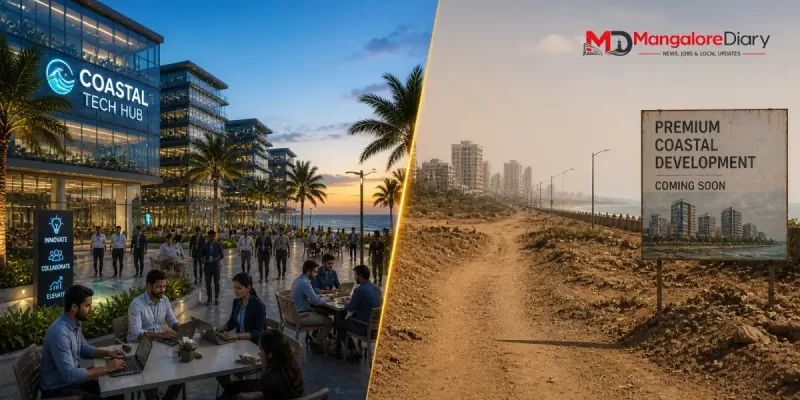
You've heard it before.
Maybe at a Technovanza event. Maybe from a politician's speech. Maybe from that one enthusiastic LinkedIn post by a local startup founder.
"Mangalore is the Silicon Beach of India."
And honestly? The first time you hear it, it gives you goosebumps. A beautiful coastal city. World-class colleges. Brilliant young minds. Low cost of living. Beaches on one side, Western Ghats on the other.
Why NOT Mangalore?
But then you talk to a 24-year-old engineering graduate from Surathkal who just packed his bags for Bangalore. Or a software developer from Bejai who's been waiting two years for that "upcoming tech park" to actually open. Or a startup founder who's been hearing the same government promises since 2015.
And you start asking the real question — how much of the Silicon Beach dream is actually happening? And how much is still just a very nice PowerPoint slide?
Let's find out. No sugar-coating. Just honest ground reality.
The Problem — Why This Conversation Matters
The "Silicon Beach" idea is not new.
It has been discussed, debated, announced, and re-announced for over two decades in Mangalore. Government missions have come and gone. Events have been held. Reports have been published. Funding has been promised.
And yet — every year — thousands of young, educated Mangaloreans still board the train to Bangalore or the flight to Dubai.
The gap between the vision of Silicon Beach and the daily reality on the ground is the story nobody is telling honestly.
Because the truth is more complicated than both the pessimists and the enthusiasts want to admit.
Mangalore is neither failing completely — nor succeeding fast enough. It is somewhere in between, at a genuinely critical crossroads.
And how it navigates the next 5 years will define whether "Silicon Beach" becomes a real identity — or just a marketing tagline that gets updated every election cycle.
The Full Breakdown — Expectations vs. Reality
THE EXPECTATIONS — What the Dream Looks Like
Let's be fair. The vision is genuinely exciting.
The talent pool is real and massive.
The Mangaluru-Udupi cluster boasts a professional workforce of 240,000, including 150,000 fresh graduates and 90,000 experienced professionals. Premier institutions like NITK Surathkal and Manipal Academy of Higher Education produce over 15,000 graduates every year.
That is not a small number. That is a serious talent base.
The government has shown up — at least on paper.
The Karnataka government announced plans for Mangalore's largest technology park — spanning 3.25 acres with a built-up area of 3.5 lakh sq ft and working capacity for 3,500 professionals. The state has also been pushing its "Beyond Bengaluru" mission, actively trying to pull companies away from Bangalore.
The startup ecosystem is growing — quietly.
Across four editions of Beyond Bengaluru Blue, the programme has engaged 400+ startups, identified 36 fundable ventures, and unlocked ₹1.5 crore in early-stage funding, helping companies like BlackFrog Technologies and Sonic Labs expand into global markets.
Homegrown champions are also emerging. Companies like Robosoft Technologies, Niveus Solutions (acquired by NTT Data), Novigo Solutions (part of R Systems), and 99Games — all born and built in Mangalore — show that world-class companies can be built here.
The cost advantage is undeniable.
Mangaluru has minimized operational costs compared to other cities in India — around 10% lower costs. During recession, these lower operational costs help the IT sector.
Add to that — affordable rents, a cleaner and less chaotic city, better work-life balance, and proximity to nature. On paper, Mangalore beats Bangalore on quality of life easily.
THE REALITY — What's Actually Happening on the Ground
Now — the honest part.
The IT park promise is embarrassingly old.
Despite several public declarations about its progress, there has been no significant advancement thus far. Rohith Bhat, a founding member of Silicon Beach Program and founder of Wrkwrk, 99Games, and Robosoft, expressed frustration over the lack of progress, saying "the government has been promising the start of this project for years, but nothing substantial has been done."
Read that again. The founder of Mangalore's most successful tech companies — the very man who should be the most optimistic person in the room — is publicly frustrated.
One commenter on a local news article put it bluntly: "I am listening since my younger days. Now I am 53. That Mangalore will become a Silicon city. But till today nothing like anything is happening."
Twenty-three years. Same promise. Different speaker. Same microphone.
The numbers, while growing, are still modest.
Mangaluru already hosts over 250 IT companies employing more than 18,000 professionals. In 2024, 20 new companies were added, with further growth expected.
18,000 IT professionals sounds good — until you compare it to Bangalore's 1.5 million+ tech workforce. Mangalore is still a fraction of the scale needed to call itself a genuine tech hub.
Infrastructure is a genuine bottleneck.
Roads, traffic management, and basic civic infrastructure remain serious problems. As recently as February 2026, residents of areas in Mangaluru staged protests demanding permanent solutions to long-pending issues related to roads, traffic, safety, and underground drainage, which have plagued the area for several years.
You cannot attract IT companies and their employees if basic roads are not functional. No amount of "Silicon Beach" branding fixes a broken drainage system or a traffic jam that adds 45 minutes to a 10-minute commute.
The funding gap is real.
The Beyond Bengaluru Blue programme has unlocked ₹1.5 crore in early-stage funding across four editions. That's roughly ₹4 lakh per funded startup on average. In a world where even a basic MVP costs ₹5-10 lakhs to build — that is a very thin safety net for entrepreneurs taking real risks.
Bangalore startups raise crores in seed rounds. Mangalore startups are celebrating ₹4 lakh in funding. That gap tells you everything about the ecosystem maturity difference.
Brain drain is still happening — and it's the biggest signal.
The fact that NITK Surathkal — one of India's top engineering colleges — sits in Mangalore, yet most of its graduates leave immediately after placement, tells you the ecosystem is not yet strong enough to retain its own best people.
THE IN-BETWEEN — Where It's Getting Genuinely Better
To be fair — there are real, tangible green shoots.
Rohith Bhat noted that the expansion of plug-and-play office spaces, the region positioning itself as a new data centre infrastructure hub, and strong industry-academia linkages are giving entrepreneurs the confidence to build globally competitive businesses while remaining rooted here.
The report underscores a forward-looking vision to position Silicon Beach as a globally recognized hub for startups, GCCs, and enterprise growth, anchored in talent development, leadership retention, and education-industry integration.
The government is encouraging startups to develop solutions related to marine life, aquaculture, and ocean sustainability, positioning Mangalore for maritime and blue economy initiatives — a genuinely smart play given the city's coastal location.
And the Bengaluru-Mangalore Expressway — once complete — will cut travel time between the two cities to just 4.5 hours, which will encourage IT professionals and businesses to invest in Mangalore.
These are not just words. Some of these things are actually moving. Slowly — but moving.
In Real-Life Example — Two Mangaloreans, Two Different Stories
Story 1 — Rahul, 27, Software Developer
Rahul graduated from a Mangalore engineering college in 2020. He got a job offer from a Bangalore company — ₹6 LPA. He took it.
Today he earns ₹14 LPA in Bangalore. But his rent is ₹22,000 a month. His commute is 2 hours daily. He hasn't slept before midnight in two years.
He told me recently: "If there was a proper company paying ₹10 LPA in Mangalore, I would go back tomorrow. The quality of life comparison is not even close."
The demand to return is there. The opportunity is missing.
Story 2 — Shraddha, 29, Startup Founder
Shraddha stayed back in Mangalore after college. She started a B2B SaaS product for small hospitality businesses — hotels and homestays across coastal Karnataka.
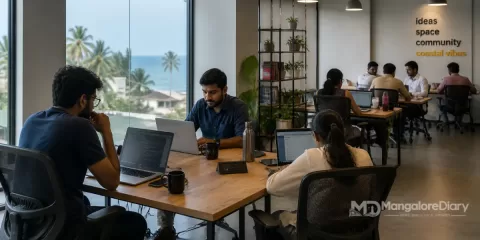
She uses coworking space. She hired 5 local developers. She's bootstrapped and profitable.
"People told me I was crazy to build a startup in Mangalore. But my costs are so low, my team is so loyal, and my lifestyle is so good — I wouldn't trade it for a Bangalore office even if someone paid me."
Both stories are true. Both are Mangalore. The city can be either — depending on what support systems exist around you.
Actionable Tips
For Mangalorean Youth in Tech:
- Don't wait for the ecosystem to be perfect before you start. Shraddha didn't. The coworking spaces, mentors, and remote work culture are already here. Use them now.
- Build remote-first. You can work for Bangalore, Mumbai, or US companies while living in Mangalore. ₹80,000/month remote salary + Mangalore cost of living = better life than most Bangalore employees. Do the math.
- Join the Silicon Beach Program community. It's a real, active network of people trying to build the ecosystem. Connections there are worth more than any job fair.
- Upskill in niche areas — AI/ML, cloud architecture, cybersecurity, marine tech. Generic software skills face competition everywhere. Niche skills make you irreplaceable and attract better remote opportunities.
- Look at the blue economy angle. Mangalore's marine and port ecosystem is genuinely unique. Tech solutions for fisheries, aquaculture, port logistics, and coastal tourism are wide open opportunities that nobody in Bangalore is building.
For Local Entrepreneurs:
- Use the cost advantage aggressively. ₹50 lakh in Mangalore can build what ₹2 crore barely does in Bangalore. That's not a minor difference — that's a different game entirely.
- Target Mangalorean NRI communities abroad as your first customers. They trust local brands and are digitally active. It's a ready market most local startups ignore.
- Apply for KDEM's Beyond Bengaluru programmes. The funding is small but the mentorship network, visibility, and connections to bigger investors are real.
For the Government (yes, we're putting this here):
- Just build the tech park. Stop announcing it. Stop the DPR stage. Stop the Cabinet proposal stage. Start construction. The private sector has shown it can fill it — Robosoft, 99Games, Niveus all proved that. Give them a building and watch what happens.
- Fix the roads first. No GCC will shift 500 employees to a city where the daily commute is a survival challenge. Basic infrastructure is not optional for a tech hub.
- Create a Mangalore-specific VC fund — even ₹25 crore deployed into 20-25 local startups annually would transform the ecosystem in 3 years.
For NRIs from Mangalore:
- Your Gulf money needs a new address. Land and gold have limits. A ₹25-50 lakh angel investment in a promising local startup could generate returns AND keep your nephew employed in his hometown.
- Come back — at least as a mentor. Your international experience is genuinely rare and valuable to a 25-year-old trying to build a product company in Mangalore.
Conclusion
The Silicon Beach dream is not a lie.
But it is not yet a truth either.
It is something harder — a work in progress that keeps getting interrupted by slow governance, underfunded ecosystems, and the magnetic pull of Bangalore.
Here is what is real: The talent is here. The cost advantage is here. The quality of life is here. Companies like Robosoft and 99Games proved it is possible to build world-class products from this city. The government — however slowly — is beginning to move.
Here is what is missing: Speed. Infrastructure. Funding. And most of all — the collective belief that Mangalore doesn't need to become the next Bangalore. It needs to become the best version of Mangalore.
Because the city doesn't need 10 lakh IT workers and traffic jams like Silk Board junction. It needs 50,000 well-paid, fulfilled tech professionals living great lives by the sea — building products for the world from a city that actually deserves to be lived in.
That's the Silicon Beach worth building.
The dream is possible. The question is — does Mangalore have the patience and the push to make it real?
FAQ
What exactly is the "Silicon Beach" concept for Mangalore?
Silicon Beach is a vision — and also a formal initiative — to transform the Mangalore-Udupi coastal belt into a major technology and startup hub, similar to how Bangalore is India's Silicon Valley. The Silicon Beach Program is a Section 8 company working with local entrepreneurs, the government, and institutions to build this ecosystem. The Karnataka government's "Beyond Bengaluru" mission has also adopted this vision as a key pillar of its policy.
How many IT companies and tech professionals are currently in Mangalore?
As of early 2025, Mangaluru hosts over 250 IT companies employing more than 18,000 professionals, with 20 new companies added in 2024 alone. The numbers are growing — but still significantly smaller than major IT hubs like Bangalore, Hyderabad, or Pune.
What is the main thing holding Mangalore back from becoming a real tech hub?
Honestly — it's a combination of three things. First, delayed government infrastructure (especially the long-promised IT park). Second, limited startup funding compared to larger cities. Third, the perception problem — companies and talent still default to Bangalore because the ecosystem there is more established. Breaking that default habit requires visible wins, which requires the first two problems to be solved. It's a chicken-and-egg situation.
Is it worth starting a tech startup in Mangalore today?
For the right kind of startup — yes, genuinely. Mangalore ranks 4th out of 37 Karnataka districts in Ease of Doing Business, has a cost of living index of 19.12, and 40% cleaner air than metros. If your startup can operate remotely or serves a niche that doesn't require a large local customer base, the cost and lifestyle advantages are real. The ecosystem support is growing, even if slowly.
What are the biggest IT companies currently in Mangalore?
Global players like Infosys, Wipro, and Cognizant have presence in Mangalore, alongside homegrown champions like Robosoft Technologies, Niveus Solutions (acquired by NTT Data), Novigo Solutions (part of R Systems), and 99Games. There are also a growing number of smaller product companies, agencies, and GCC outposts setting up operations.
What is the Beyond Bengaluru Mission and how does it help Mangalore?
Beyond Bengaluru is Karnataka government's initiative to develop tech and startup ecosystems in cities outside Bangalore. For Mangalore specifically, it has supported events like Technovanza, provided early-stage funding to startups, and pushed for the tech park development. The broader program has invested ₹1,000 crore through a cluster-based Local Economy Acceleration Program across Karnataka, with Mangaluru identified as one of the key clusters.
What is the Bengaluru-Mangalore Expressway and how will it affect Silicon Beach?
The 10-lane Bengaluru-Mangalore Expressway will cut travel time between the two cities to just 4.5 hours. This is significant — it will make Mangalore a viable satellite city for Bangalore-based companies looking for cheaper office space, and will make it easier for Mangaloreans to access Bangalore opportunities without permanently relocating. It could be a significant catalyst for the tech ecosystem if completed on schedule.
How can an NRI from Mangalore contribute to the Silicon Beach vision?
Several ways — angel investing in local startups (even ₹10-25 lakh can be life-changing for an early-stage Mangalorean startup), mentoring young entrepreneurs through community networks, using professional connections abroad to open market doors for local companies, and advocating for Mangalore as a business destination within your professional circles. The NRI community is one of Mangalore's most underutilised assets for local economic development.
Written for MangaloreDiary.in — Because Mangalore deserves honest conversations, not just hype.


0 Comments
Leave a Comment