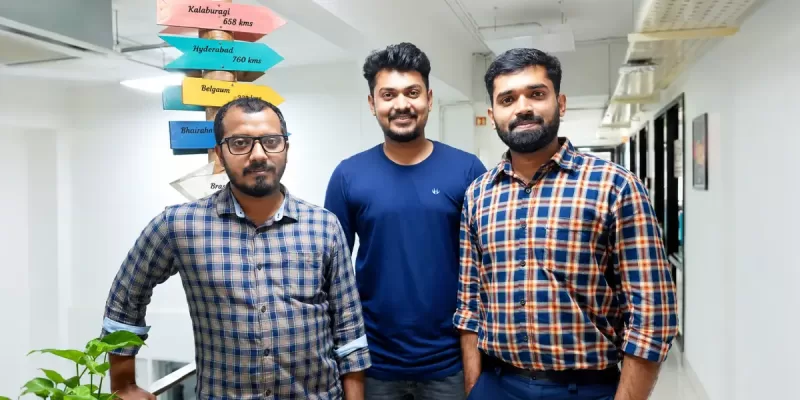
Three founders, one failed startup each, and ₹100 in seed capital — how MicroDegree built an edtech platform that teaches AWS, DevOps and full-stack development to Karnataka's Tier II and III towns in the language they actually think in.
When Your Best Idea Comes After Your First One Fails
Every founder story in this feature so far has involved someone who saw a problem clearly from the start. MicroDegree's origin is a little more honest than that: it began with three engineers whose individual startups had already failed, meeting almost by accident.
Gaurav Kamath, Rakesh Kothari and Manikanta Nair met through CEOL — a startup incubation centre in Mangaluru supported through Union Finance Minister Nirmala Sitharaman's MPLADS (Member of Parliament Local Area Development Scheme) funds. "We were running our own startups, which failed. That's when we met together and thought of solving the challenge of upskilling local talent in local languages," Gaurav Kamath told YourStory in 2022.
The problem they landed on was specific and, once you hear it, obvious: engineering students across Karnataka's smaller towns were fluent in their subjects but not always in English, and that language gap — not a lack of ability — was quietly locking them out of IT careers. MicroDegree's answer was to teach programming and job-ready tech skills in Kannada.
Starting With ₹100 and a Stack of Pamphlets
MicroDegree was founded in November 2019 (some later press coverage rounds this to "2020," reflecting the point at which the platform moved from an offline pilot to full operation, so we've noted both dates rather than picking one arbitrarily). The founders' first move was almost defiantly low-tech for a company that would go on to teach cloud computing: they invested Rs 100, printed pamphlets, and distributed them across colleges by hand.
That pamphlet drive brought in more than fifty paying students interested in learning full-stack development. Because the founding team had strong technical backgrounds themselves, they ran the first cohort offline, on a pilot basis, funded directly by that initial batch of course fees rather than outside capital. It was only after that offline proof of concept worked that MicroDegree scaled onto an online platform.
A Government Stamp of Approval, Early
In March 2020, MicroDegree was selected among the top 93 startups (out of more than 1,000 applicants) in Startup Karnataka's flagship Elevate-Call2 programme — an early, credible signal for a company that had started with pamphlets a few months earlier. The recognition helped MicroDegree access the incubation and mentorship infrastructure of RIIDL (Research Innovation Incubation Design Labs), the incubator run by Mumbai's Somaiya Vidyavihar group, which went on to back the company with seed funding alongside 100X.VC.
By 2021, MicroDegree had grown enough to be invited to the Bengaluru Tech Summit's "Bengaluru Next Innovators Conclave," where it was recognised by the Karnataka Digital Economy Mission (KDEM) alongside the state's genuine unicorns and soonicorns — Zerodha, Meesho, Dailyhunt, CRED and Mobile Premier League — a notable room for a company teaching coding in Kannada to Tier II and III students to find itself in.
The Team Behind the Idea
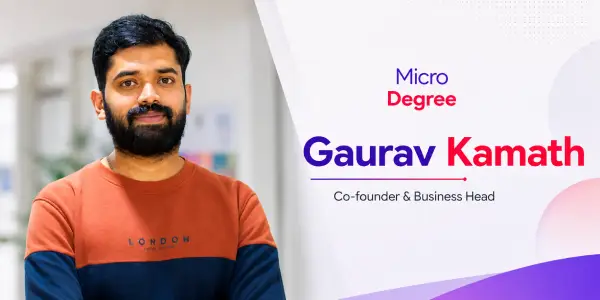
Gaurav Kamath studied at N.M.A.M. Institute of Technology (NMAMIT), Nitte, before beginning his professional career as an Application Development Associate at Accenture from June 2016 to May 2017. He moved into business development at Tracxn from January to July 2018, and that same month, co-founded his first startup, Nebor. When Nebor did not work out, he co-founded MicroDegree in November 2019 and has led it as CEO since.
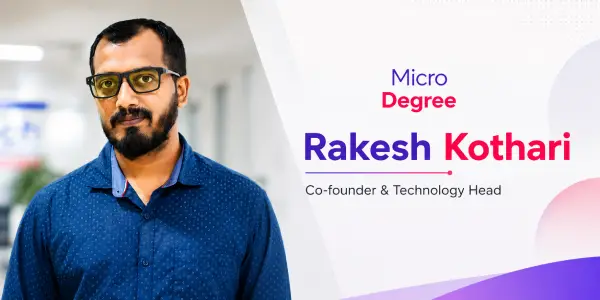
Rakesh Kothari brings the most extensive corporate technology background of the three founders. He completed his pre-university studies at a Jawahar Navodaya Vidyalaya before earning a Bachelor of Engineering in Electronics Engineering from BMS College of Engineering, Bangalore, between 2005 and 2009. His career included progressively senior roles at Tata Consultancy Services — from Junior Software Engineer to Software Developer to Technical Lead on the Bank of America account — followed by a stint as Senior Software Developer at Highmark Inc. in Pittsburgh, United States. Before MicroDegree, he also served as Entrepreneur in Residence at the Manipal Universal Technology Business Incubator (MUTBI), mentoring early-stage founders — experience that fed directly into building MicroDegree's own technology and product roadmap.
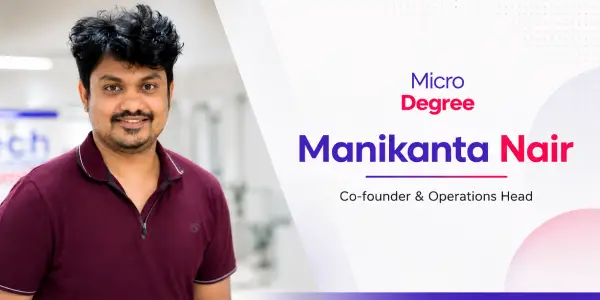
Manikanta Nair holds a Bachelor of Engineering in Computer Science from P.A. College of Engineering, Mangaluru, and worked as a MERN Stack Developer at TechMustr before co-founding MicroDegree, where he has led operations and sales.
What MicroDegree Actually Teaches, and Who It's For
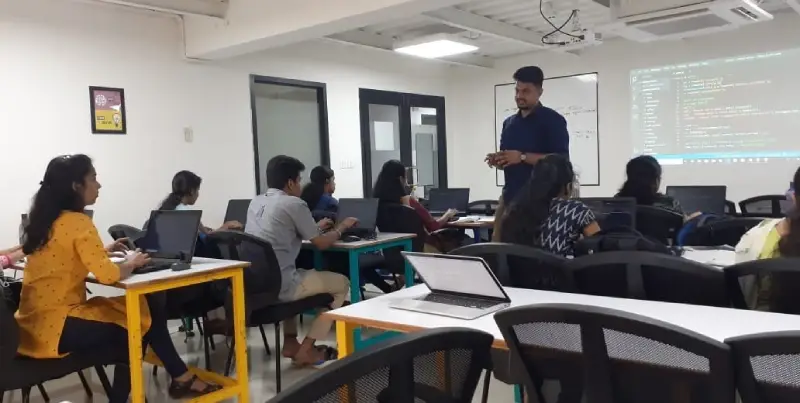
MicroDegree's core offering is straightforward: live and self-paced online courses in in-demand technical skills — cloud computing, Python, AWS, DevOps, and full-stack web development among them — taught in Kannada rather than English, aimed squarely at working professionals looking to upskill and freshers preparing for their first tech job. Courses typically run for about two months, in weekday or weekend batches, with recordings available for anyone who misses a live session.
The company's explicit mission is to remove language as a barrier to a tech career — its own materials describe the goal as helping local engineering talent gain "foundational clarity in vernacular" language and connecting them to the right job opportunities, rather than assuming Tier II and III students should simply struggle through English-medium content designed for a different audience.
By 2022, MicroDegree had onboarded more than 10,000 learners, most from Tier II and III towns rather than metro cities, with its Android app crossing 3,000 downloads at the time. More recent company materials put the total learner base at over 50,000. As of mid-2024, the company employed around 44 people, up from a team of about 20 in 2022 — a team the founders had, at that point, hoped to grow past 200 within six months, a target that, based on the 2024 employee count, appears not to have been fully reached on that timeline.
The Business Side
MicroDegree has raised a total of $185,000 (roughly ₹1.5 crore) across three funding rounds from RIIDL and 100X.VC, according to Tracxn's company data. For the financial year ending 31 March 2025, the company's annual revenue was reported at ₹3.36 crore. It now competes in a crowded vernacular and vocational ed-tech space alongside players like GUVI, Entri, and the ffreedom App.
The company operates out of the MicroDegree k-Tech Innovation Hub at the Plama Center on Bejai Kapikad Road in Mangaluru.
What's Next
Recent public posts from co-founder Rakesh Kothari suggest the company is now working on an AI-powered test-preparation platform internally referred to as "Arena," and reflecting more broadly on Mangaluru and Udupi's emergence as a growing tech hub — sometimes referred to informally as the "Silicon Beach of India" in local tech circles. We want to flag that these details come from the co-founder's own recent social media posts rather than a formal company announcement, so they should be read as an indication of current direction rather than a confirmed, finished product.
Why This Story Matters for Coastal Karnataka
MicroDegree is a useful counterpoint to the entrepreneur stories in our earlier feature on Mangalore-origin business leaders. Where K.V. Kamath, Devi Shetty, the Pai family and Jayshree Ullal each built institutions with global reach, MicroDegree is solving a much more local, much more specific problem: the fact that a bright engineering student in a Tier II or III Karnataka town, whose English isn't yet fluent, deserves the same shot at a tech career as anyone else. It is a smaller story, but not a lesser one, and it is very specifically a Mangaluru story — from the incubator that brought its founders together to the language its courses are taught in.





0 Comments
Leave a Comment