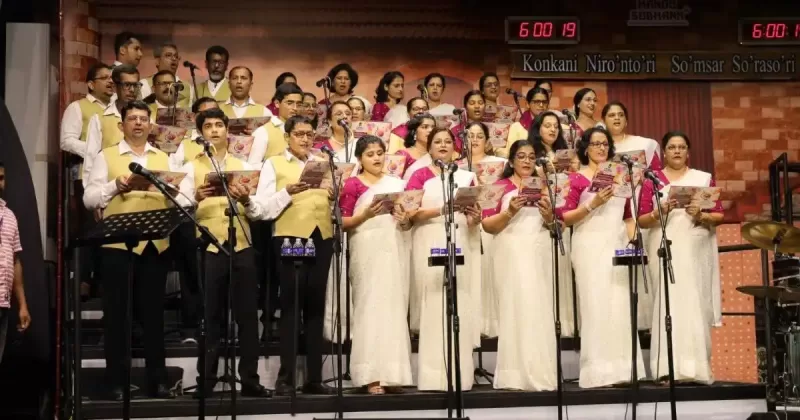
At 6 am on Tuesday, 3 November, Goa Chief Minister Dr Pramod Sawant played the gumot, a traditional percussion instrument, on the Town Hall stage in Mangaluru. The singing began. It is not meant to stop until 6.12 pm on 15 November.
That is the plan behind the First World Konkani Music Mega Convention, organised by Mandd Sobhann as part of its Ruby Jubilee, its 40th year. The centrepiece is a Guinness World Records title attempt for the longest singing marathon by multiple singers: 12 days, 12 hours and 12 minutes, or 300 hours and 12 minutes, of Konkani song.
300 teams, one hour each, no singer and no song repeated.
Day one at Town Hall
The 13-day convention, titled Po’ylo Vishv Konknni So’ngeet Mo’hame’ll in Konkani, opened on 3 November at Town Hall. The Bishop of Mangalore, Dr Peter Paul Saldanha, joined the Chief Minister in lighting the lamp.
Dr Sawant said that dialects may differ but Konkani people remain united in heart and language. He noted that Konkani is the official language of Goa and receives state support there, while the Konkani-speaking community in Mangaluru has kept the language alive through its own dedication. The Goa government, he added, considers Konkani achievers from outside Goa for its state awards.
Michael Lobo, MLA from Calangute in Goa, praised the late Eric Ozario for his lifelong work for Konkani culture and for giving young talent a platform. The whole event is dedicated to Ozario's memory. He was the founder and Gurkar of Mandd Sobhann, and the record attempt was first announced on 31 August 2025, at his funeral.
Mandd Sobhann president Louis J Pinto welcomed the gathering. Ivan D’Souza (MLC), Delilah Lobo (MLA, Siolim), Stany Alvares (president, Karnataka Konkani Sahitya Akademi) and Joyce Ozario were among those present.
How the record attempt works
The Guinness World Records attempt at a glance
| Item | Detail | Note |
|---|---|---|
| Title attempted | Longest singing marathon (multiple singers) | Guinness World Records category |
| Name of the marathon | Konko’nni Niro’nto’ri – So’msar So’raso’ri (Eternal Konkani – Unto the World’s End) | As translated by the organisers |
| Start | 6 am, 3 November 2026 | Town Hall, Mangaluru |
| Scheduled end | 6.12 pm, 15 November 2026 | Followed by the valedictory programme |
| Length | 12 days, 12 hours and 12 minutes (300 hours 12 minutes) | Non-stop |
| Format | 300 teams, each singing for one hour, in rotation | No singer or song repeated |
| Chief music director | Sangeeth Guru Joel Pereira | |
| Verification | Registered with the Guinness office in London; an official adjudicator has been appointed | Result depends on verification |
Who is singing
The scale of the marathon, as reported by the organisers
| Measure | Reported figure | Note |
|---|---|---|
| Singers | More than 6,700 (6,789 in one report) | Expected across the 12 days |
| Teams | 300, including 53 teams from Goa | One hour each |
| Songs | More than 4,500 | From diverse dialects and communities |
| Composers and arrangers | More than 250 | Contributed to the preparations |
| Countries | India, Australia, Kuwait, Oman and Qatar | Per the organisers |
| Estimated budget | About Rs 3 crore | Per the organisers |
Singers from Christian, Hindu and Muslim communities are taking part. The communities named include Konkani Christians, Gaud Saraswat Brahmins, Kudal Deshastha, Kharvi, Kudumi, Siddi, Nawayathi and Syrian Christian groups.
An Australian team, Australia-che Amig, is scheduled to perform on 3 November at 7 pm Indian Standard Time.
Beyond the singing
The marathon sits inside a wider convention.
Twelve seminars will cover Konkani devotional music in Goa and Mangaluru, folk traditions, music and health, international music, baila, musicians and their compositions, theatre and cinema music, and the influence of Mandd Sobhann's own work. Other topics are intellectual property rights and the role of artificial intelligence in music.
Twelve senior musicians will receive the World Konkani Musical Excellence Award, five of them posthumously. The names announced are Chris Perry, Lawrence Saldanha, Fr Lino D’Mello, Melwyn Peris, Nemiraja Gowda, Jerome D’Sa, Vasanthi R Nayak, Alfred Rose, Shridhar Kharvi Cha, Mamdu Ibrahim, Ulias Buyão and Juliana Siddi.
Ful Fulota (The Flower Is Blooming), a programme for children aged 10 to 16, is planned for 13 November at the Rajaji Park Amphitheatre, opposite Town Hall.
An exhibition at Town Hall tells the history of Konkani music and the life and traditions of Konkani communities. A Hall of Fame honours senior and contemporary musicians. Food stalls serve dishes from different Konkani communities.
Fixed dates and programmes announced so far
| Date | Programme | Venue |
|---|---|---|
| 3 November, 6 am | Opening of the convention and start of the marathon | Town Hall, Mangaluru |
| 3 November, 7 pm | Performance by Australia-che Amig | Town Hall, Mangaluru |
| 13 November | Ful Fulota, a children's music programme (ages 10 to 16) | Rajaji Park Amphitheatre |
| 15 November, 6.12 pm | Scheduled end of the marathon, then the stage programme and valedictory, with Chief Minister D K Shivakumar scheduled to attend | Town Hall, Mangaluru |
| Through the convention | 12 seminars, the exhibition, the Hall of Fame and food stalls | Town Hall premises |
Dates for the individual seminars and the award presentation have not been published.
One language, many dialects and communities, one stage for 12 days.
Why it took more than a year
The preparations began right after the 31 August 2025 announcement. Organisers compiled thousands of songs, documented lyrics, formed the 300 teams, prepared musical tracks and karaoke versions, and ran rehearsals supervised by about 40 assistant music coordinators. They also arranged attendance records, participant declarations, accommodation, travel, catering and volunteer training.
Mandd Sobhann was founded in 1986 and works to preserve and promote Konkani language, literature, theatre, music and culture. The organisers describe the Rs 3 crore estimated budget as an investment in preserving Konkani heritage and carrying it to a wider audience.
Following and attending
The convention runs at Town Hall, Mangaluru, until 15 November. The organisers have appealed to the public and to Konkani communities worldwide to take part in large numbers. The reports do not mention ticketing or entry timings for visitors, so check with the organisers before heading out. Venue details, a map and a calendar link are on the Mangalore Diary event page.
Related Articles
- Migration Stories: How Goan Catholics, Konkani Merchants, Kerala Neighbours and Other Newcomers Shaped Mangaluru: the history behind Mangaluru's Konkani-speaking communities. https://mangalorediary.in/post/migration-stories-goan-catholics-konkani-kerala-north-indian-shaped-mangaluru
- People of Mangalore: The Complete Guide to Coastal Karnataka's Culture, Languages, Communities and Festivals: the coast's languages and communities in one place. https://mangalorediary.in/post/people-of-mangalore
- 10 Years of Tulu Wikipedia: How a Handful of Volunteers Took a Coastal Language to the World: another coastal language finding a wider audience. https://mangalorediary.in/post/10-years-tulu-wikipedia-coastal-language-world


0 Comments
Leave a Comment