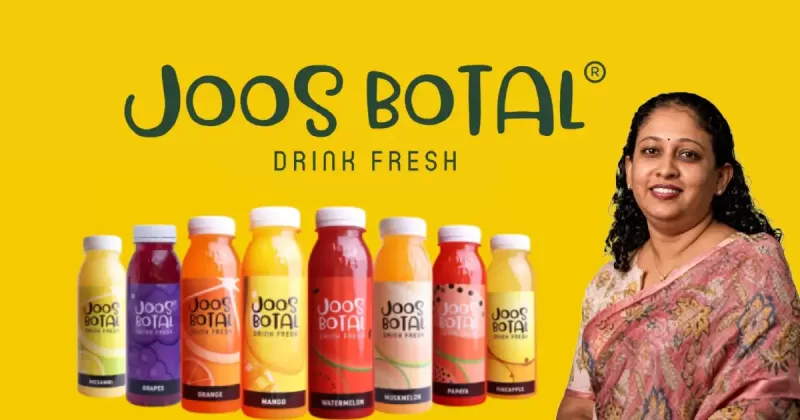
An XLRI graduate swapped the corporate track for cold-pressed juice, built Joos Botal into a multi-outlet Mangaluru brand under her own Healthbricks label — and is now learning, outlet by outlet, what it actually takes to scale food and beverage in a tier-2 coastal city. Preethi Nayak co-founded Joos Botal to bring preservative-free, cold-pressed juice to Mangaluru, built it out under her own Healthbricks label across several city outlets, and has become a familiar voice in the city's startup circles. Her journey is also a real-world lesson in how hard it is to scale food and beverage outside India's metros.
A Different Kind of Bottle on Mangaluru's Shelves
Walk into any one of Joos Botal's outlets in Mangaluru, and the pitch is right there on the label: no preservatives, no artificial flavours, no added colours. Just fruit, cold-pressed into a bottle. It sounds simple. Running a business on that promise, in a city where most juice is still sold fresh-squeezed at a roadside stall for a fraction of the price, has turned out to be anything but.
Preethi Nayak co-founded Joos Botal to make that bet anyway. An XLRI Jamshedpur graduate, she took a path that is still uncommon among her peers from India's top business schools — building a hyperlocal food and beverage brand from the ground up in a coastal tier-2 city, rather than joining a corporate career track in a metro.
From an Idea to a Registered Brand
Joos Botal operates under Healthbricks, the proprietorship through which Nayak has formally trademarked the brand — registered as "Joos Botal - Drink Fresh," covering non-alcoholic beverages, fruit juices, and related preparations. That formal registration matters more than it might seem: it is the difference between a juice stall with a catchy name and a brand built to be defended, franchised, or scaled.
As Co-Founder, Nayak has described her own role as spanning production operations and sales — the unglamorous backbone work of actually running a perishable-goods food business, far removed from the marketing gloss that often fronts a consumer brand.
What "Scaling" Has Actually Looked Like
Over the years, Joos Botal outlets have appeared across several Mangaluru neighbourhoods — including Lalbagh on M.G. Road, Kodailbail, Bendoor, and Maroli, with at least one additional retail point operating from inside a BPCL fuel station at Lady Hill. That last detail is itself a small masterclass in tier-2 retail strategy: rather than committing to expensive standalone storefronts everywhere, the brand has used high-footfall, low-overhead spaces like fuel station forecourts to put bottles within reach of commuters.
Not every outlet has survived. Public listings for the Kodailbail and Bendoor locations currently show them as permanently closed, even as the Lalbagh outlet remains active and well-reviewed, with a rating above 4 out of 5 across hundreds of customer reviews on food delivery platforms. That pattern — some outlets thriving, others quietly shutting — is not a story anyone puts in a press release, but it is the real, visible texture of what scaling an F&B brand in a city like Mangaluru actually involves: constant, outlet-by-outlet recalibration, not a straight line upward.
The Hidden Complexity Behind a Bottle of Juice
Nayak has spoken publicly, including in at least one podcast appearance, about what she has called the hidden complexity of the fresh juice business — a framing that captures something true about this category specifically. A cold-pressed juice with no preservatives typically has a shelf life measured in just a couple of days, not weeks. That single fact cascades into almost every operational decision a brand like Joos Botal has to make: how much fruit to buy and when, how tightly production has to track daily demand at each outlet, how the product moves from press to bottle to shelf to customer before it spoils, and how much of that chain can realistically be centralised versus run outlet by outlet.
Sourcing sits underneath all of it. A preservative-free juice brand lives or dies on the freshness and consistency of its raw fruit — which, in practice, means building working relationships with local growers and suppliers who can deliver quality produce reliably, season after season, even as prices and availability shift with the weather and the harvest calendar. It is a far less visible part of the business than a bottle label, but arguably the part that determines whether the promise on that label can be kept.
"No preservatives, no artificial flavours, no added colours. Just fruit, cold-pressed into a bottle."
A Familiar Voice in Mangaluru's Startup Circles
Beyond running Joos Botal day to day, Nayak has become a recognisable presence in Mangaluru's small but growing entrepreneurship ecosystem. She has spoken at Mangaluru Entrepreneurs' Day sessions on the realities of building a business, and in February 2026 was the chief guest at a college cultural festival, where she told students that academic scores alone are not enough in a world where information is freely available — a message rooted, visibly, in her own choice to build something outside the conventional XLRI-to-corporate pipeline. She has also been an active, visible figure around Mangaluru's TiE chapter events, placing Joos Botal within the same entrepreneurial circuit that has recently drawn initiatives like the TiE-backed K-Combinator startup accelerator to the city.
Why a Juice Brand Is a Useful Lens on Mangaluru Itself
It is tempting to treat a juice brand as a small story. It is actually a useful, concrete window into a bigger question Mangaluru keeps circling back to: can genuinely ambitious, quality-led consumer businesses be built and sustained here, outside Bengaluru's gravity, without either staying permanently small or being forced to relocate once they outgrow the local market?
Joos Botal has not fully answered that question yet — no single tier-2 F&B brand has. But its mix of real traction (an established, well-reviewed flagship outlet, a recognisable local brand, formal trademark protection) alongside real friction (outlets that have come and gone, the operational grind of a short-shelf-life product) is, in miniature, exactly the kind of story Mangaluru's broader "next growth hub" narrative tends to skip over in favour of headline wins. The unglamorous, outlet-by-outlet reality is the more honest version of what building something here actually looks like.
Read Next on Mangalore Diary
- Prabhakar Kamath: The Man Who Made Mangaluru the Ice Cream Capital of India
- Mangalore's Mohammed Ashiq from Juice Stall to Winning MasterChef India
- K-Combinator Comes to Mangaluru: TiE to Drive ₹9.5 Crore Startup Accelerator for Coastal Karnataka
- The Mangalore Breakfast Trail: 7 Dishes You Should Eat Before 9 AM (And Where to Find Them)
FAQ
Who is Preethi Nayak?
Preethi Nayak (Preethi Ganesh Nayak) is the Co-Founder of Joos Botal, a preservative-free, cold-pressed juice brand based in Mangaluru. She is an XLRI Jamshedpur graduate who leads production operations and sales for the brand.
What is Joos Botal?
Joos Botal is a Mangaluru-based cold-pressed juice brand, formally trademarked as "Joos Botal - Drink Fresh" under the Healthbricks label, known for manufacturing bottled juices without preservatives, artificial flavours, or added colours.
Where are Joos Botal's outlets located?
Joos Botal has operated outlets and retail points across several Mangaluru neighbourhoods, including Lalbagh, Maroli, Kodailbail, Bendoor, and a retail point at a BPCL fuel station in Lady Hill. Not all of these remain active; some are listed as permanently closed on public platforms.
What challenges does a brand like Joos Botal face in scaling?
Cold-pressed, preservative-free juice has a short shelf life, which makes daily production planning, fresh fruit sourcing, and distribution logistics far more demanding than for shelf-stable beverages. Outlet-level economics in a tier-2 city also mean some locations succeed while others close, requiring constant recalibration rather than straightforward expansion.
Is Preethi Nayak involved in Mangaluru's broader startup ecosystem?
Yes. She has spoken at Mangaluru Entrepreneurs' Day events, been a chief guest at college entrepreneurship talks, and is an active presence around Mangaluru's TiE chapter and related startup community events.






0 Comments
Leave a Comment