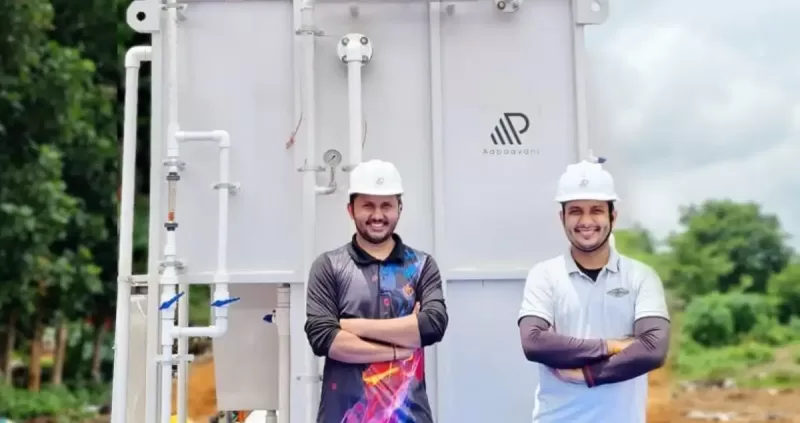
Aapaavani Environmental Solutions, founded by environmental engineers Vishnu Sharma Atikukke and Chinmaya Delampady, has built AI-integrated wastewater treatment systems for clients including Bisleri, Patanjali, Campco and Manipal Hospitals — all from a bootstrapped, Mangaluru-and-Belthangady-based base. Here's the story, and what it means for industrial compliance along the coast.
A PhD, a Day Job, and a Shared Irritation With Broken Plants
Every industrial town has them — effluent treatment plants that were installed because regulation demanded one, then quietly left to underperform because nobody had the expertise, or the will, to fix them properly. Vishnu Sharma Atikukke spent years studying exactly this kind of failure, and Chinmaya Delampady spent years watching it from inside a factory gate.
Atikukke's academic path reads like someone who kept choosing to go deeper into the same problem: a Bachelor's in Environmental Engineering from Sri Jayachamarajendra College of Engineering, Mysuru, followed by a Master's at Manipal Institute of Technology, and then a PhD in Environmental Engineering from Manipal Academy of Higher Education, with doctoral research modelling how heavy metals move through agricultural soils in the Swarna-Madisal river basin near Udupi. Along the way, he taught as an Assistant Professor at Manipal Institute of Technology.
"It ignited a spark within me and my friend, Chinmaya Delampady — together we started an Environmental Consultancy by the name Aapaavani Environmental Solutions." — Vishnu Sharma Atikukke, on the origins of the company, via his professional profile
Delampady's own degree is also a B.E. from Sri Jayachamarajendra College of Engineering — the two founders share an alma mater — but his route into the problem was different. Before co-founding Aapaavani, he worked as Deputy Manager - Environment at Mangalore Chemicals & Fertilizers, Karnataka's largest fertiliser manufacturer, which meant he had sat on the operating side of industrial compliance long before he started selling a fix for it.
Founders at a Glance
| Founder | Role at Aapaavani | Background Before Aapaavani |
|---|---|---|
| Vishnu Sharma Atikukke | Co-Founder & CTO | PhD, Environmental Engineering (Manipal Academy of Higher Education); Assistant Professor, Manipal Institute of Technology |
| Chinmaya Delampady | Co-Founder & CEO | B.E., Environmental Engineering; Deputy Manager - Environment, Mangalore Chemicals & Fertilizers |
Building a Deep-Tech Company From the Coast, Not Around It
Aapaavani Environmental Solutions Private Limited was incorporated in 2018, though both founders date their active, full-time involvement in building the company to around 2021 — the period when the consultancy began to take the shape it has today. The company is headquartered in Baikampady, an industrial pocket of Mangaluru, with a registered office in Belthangady; its own materials describe it simply as "serving across India from Mangaluru & Belthangady, Dakshina Kannada."
That geography matters more than it might first appear. Deep-tech, engineering-led startups — the kind that need PhD-level expertise, not just a slick app — are usually assumed to require a metro base, close to investors, specialised suppliers and large enterprise clients. Aapaavani has instead built its client list from a coastal Karnataka base, treating distance from Bengaluru or Mumbai as a logistics problem to solve rather than a reason to relocate.
Bootstrapped, Not VC-Backed Startup data trackers list Aapaavani as unfunded — meaning the company has grown its client base and plant deployments without external venture investment, relying instead on project revenue from the clients it has signed on.
How a Small Mangaluru Firm Ended Up Serving Bisleri and Patanjali
Aapaavani's own published client list is the clearest evidence of how far the company's reach now extends beyond coastal Karnataka: Bisleri, Nandini, Bindu, Patanjali, Ideal Chicken, Campco, Nexa, Manipal Hospitals, NITTE, and several other named institutional and industrial clients.
Aapaavani's Publicly Listed Major Clients, by Sector
| Sector | Named Clients | What That Signals |
|---|---|---|
| Bottled water & beverages | Bisleri, Nandini, Bindu | National-brand-level quality and compliance expectations |
| FMCG & food processing | Patanjali, Ideal Chicken, Campco | High-volume effluent with strict discharge norms |
| Healthcare | Manipal Hospitals | Biomedical and institutional wastewater, a more sensitive compliance category |
| Automotive & education | Nexa, NITTE | Diversification beyond food and beverage into services and campuses |
A detailed client account, from the Campco Chocolate Factory in Puttur, gives a concrete sense of how these engagements actually play out. Campco had been struggling with a conventional effluent treatment plant that could not consistently meet treatment standards. In 2023, it brought in Aapaavani, and the founders designed and executed a new greenfield 300 KLD (kilolitres per day) Membrane Bio-Reactor, or MBR, system — a plant that occupied only about 20% of the physical footprint of the old setup it replaced. Delivered on a turnkey basis under the founders' direct supervision, the system has reportedly run reliably for more than a year since.
What Is an MBR System? A Membrane Bio-Reactor combines biological wastewater treatment with membrane filtration in a single compact process — producing cleaner output in a smaller physical footprint than older, conventional treatment plants, which is part of why Aapaavani's Campco installation needed only a fraction of the space.
That pattern — a client stuck with an underperforming legacy plant, brought back into compliance through a redesigned, more compact and more automated system — appears to be the company's core playbook: not just building new plants from scratch, but rescuing failed or inefficient ones using AI/ML-integrated process control and proven technologies like MBR.
"They designed and executed a new greenfield 300 KLD MBR system that occupied only 20% of the space compared to our old plant... Aapaavani's young team brings timely expertise and a humble, sincere approach much needed in the industry." — Campco Chocolate Factory, Puttur, client testimonial published by Aapaavani
The Scale of What's Actually Being Treated
By the company's own account, 2025 alone saw its plants treat over 1.66 billion litres of wastewater — a volume the company itself has compared to roughly 664 Olympic-sized swimming pools, returned to the environment rather than discharged untreated. That is not a single headline project; it is the cumulative output of a growing portfolio of installations running day after day across multiple client sites.
Aapaavani in Numbers
| Metric | Figure | Source/Context |
|---|---|---|
| Wastewater treated in 2025 | Over 1.66 billion litres | Company's own reporting, equivalent to ~664 Olympic-sized swimming pools |
| Team size | Around 26 employees | Business data aggregator (Rocketreach), broadly consistent with other listings showing 11–50 employees |
| Company founded | 2018 (incorporation); founders' active involvement from around 2021 | Corporate registry and founders' own professional profiles |
| Funding status | Unfunded / bootstrapped | Startup data tracker (Tracxn) |
The team has also been publicly recognised for this work, receiving a Business Excellence award for entrepreneurship at a major trade event where the company says it demonstrated its AI/ML-enabled smart treatment systems to a gathering that included over a lakh visitors and delegates .
Why This Matters for Industrial Compliance on the Coast
Karnataka's environmental enforcement machinery has a persistent, well-documented problem: plenty of treatment plants exist on paper, far fewer actually meet discharge standards in practice. Regulatory coverage of the state's sewage and effluent treatment plants has repeatedly found that only a fraction of installed systems consistently satisfy pollution-control board parameters, with the rest falling short on at least one measure — whether biochemical oxygen demand, suspended solids, or another tracked indicator.
That gap is precisely the market Aapaavani has built itself around. An AI-integrated system that continuously monitors treatment parameters, rather than relying on periodic manual checks, directly addresses the kind of silent underperformance that turns a compliant-on-paper plant into a non-compliant one in practice — the exact failure mode regulators keep finding when they inspect. National regulators have separately pushed for real-time, continuous effluent and emissions monitoring at larger waste facilities, reflecting a broader direction in Indian environmental enforcement toward automated, data-backed compliance rather than spot inspections.
Why AI-Integrated Treatment Matters for Compliance
| Traditional Approach | AI-Integrated Approach | Compliance Implication |
|---|---|---|
| Periodic manual sampling and checks | Continuous, automated monitoring of treatment parameters | Non-compliance is caught in near real time, not at the next inspection |
| Fixed, static process settings | Intelligent process control that adjusts to inflow conditions | More consistent output quality even as influent varies |
| Underperformance often goes unnoticed until inspection | Performance data available for self-reporting and audits | Easier for clients to demonstrate, not just claim, regulatory compliance |
"A gap in Karnataka's enforcement machinery — plants that exist on paper but underperform in practice — is precisely the market Aapaavani has built itself around."
For large clients like Bisleri, Patanjali and Manipal Hospitals, the appeal is not abstract: consistent, demonstrable regulatory compliance protects brand reputation at a scale where a single pollution-control notice can become a national news story. For coastal Karnataka's own industrial base — chemical plants, food processors, hospitals and educational campuses — a locally based firm capable of delivering that same standard means compliance expertise no longer has to be imported from Bengaluru or Mumbai on a project-by-project basis.
A Second Venture, and a Still-Unfolding Story
Both founders have also co-founded a second company together, Replastiko Private Limited, described in their own professional profiles as operating in the retail sector — a detail that suggests Atikukke and Delampady's partnership extends beyond a single business idea into a broader, ongoing collaboration on environmental and sustainability-linked ventures. Full details of Replastiko's operations were not independently confirmed for this article.
What is clear is that Aapaavani's story so far runs against a common assumption about Indian deep-tech: that serious engineering-led startups need to be built in, or quickly move to, a metro hub to access capital, talent and large clients. Built instead from Baikampady and Belthangady, bootstrapped without outside investment, and run by two engineers who met the same technical problem from opposite sides of a factory fence, Aapaavani has so far made the opposite bet — and landed national-brand clients while making it.
Read Next on Mangalore Diary
- K-Combinator Comes to Mangaluru: TiE to Drive ₹9.5 Crore Startup Accelerator for Coastal Karnataka
- Rohith Bhat: The Udupi Entrepreneur Who Built a Global Gaming Studio Without Leaving Home
- Why MRPL Is One of the Most Strategically Important Companies in Mangaluru
- Is Mangaluru Becoming Karnataka's Next Technology Hub?
FAQ
Who founded Aapaavani Environmental Solutions?
Vishnu Sharma Atikukke, who holds a PhD in Environmental Engineering, and Chinmaya Delampady, a former Deputy Manager - Environment at Mangalore Chemicals & Fertilizers. Both hold engineering degrees from Sri Jayachamarajendra College of Engineering, Mysuru.
Where is Aapaavani based?
The company is headquartered in Baikampady, Mangaluru, with a registered office in Belthangady, Dakshina Kannada district, Karnataka.
What kind of clients does Aapaavani serve?
Its publicly listed clients include Bisleri, Nandini, Bindu, Patanjali, Ideal Chicken, Campco, Manipal Hospitals, Nexa and NITTE, spanning beverages, FMCG, food processing, healthcare, automotive and education sectors.
What technology does Aapaavani use?
The company integrates AI/ML algorithms and intelligent process control with proven treatment technologies such as Membrane Bio-Reactors (MBR), both for new plant construction and for upgrading failed or inefficient existing treatment systems.
Is Aapaavani a venture-funded startup?
No. Startup data trackers list the company as unfunded, meaning it has grown through project revenue rather than external venture investment.
How much wastewater has Aapaavani treated?
By the company's own account, its plants treated over 1.66 billion litres of wastewater in 2025 alone — equivalent to roughly 664 Olympic-sized swimming pools.
When was Aapaavani founded?
The company was incorporated in 2018; both founders describe their active, full-time involvement in building the business as beginning around 2021.

0 Comments
Leave a Comment