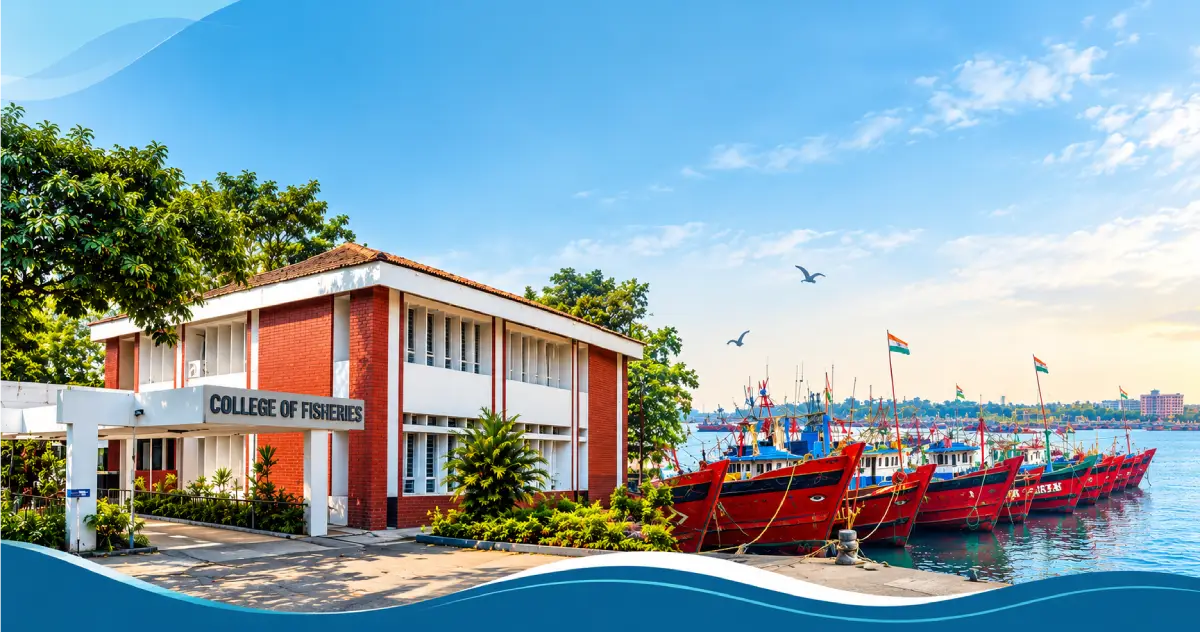
A 1969 college that trained India's first fisheries science graduates is being upgraded into a full university — with a marine biotech institute, seaweed incentives, and more than triple the seats — as Karnataka bets big on the blue economy
Where Fisheries Science in India Actually Began
Long before "blue economy" became a policy buzzword, Mangaluru already had a small, unglamorous institution quietly doing the work the phrase now describes.
The College of Fisheries in Mangaluru was established in 1969 by the University of Agricultural Sciences, Bangalore — the first fisheries college in India to be set up under the agricultural university system of the Indian Council of Agricultural Research. Decades before India talked seriously about ocean economies, this campus at Yekkur was already training people to study fish, water and coastal livelihoods as a science.
The college runs on two campuses that mirror the two halves of fisheries work itself. The main campus at Yekkur, Kankanady houses the administrative block, library, hostels, and departments of Aquaculture, Fishery Microbiology, Fisheries Resources and Management, and Fisheries Environment and Ecology. A second Technology Wing sits at Hoige Bazar, right where the Nethravathi river meets the Arabian Sea — fittingly, this is where the Departments of Fish Processing Technology and Fishery Engineering are based, closest to the boats and the catch they study.
The college currently offers Bachelor's, Master's and Doctoral programmes in Fisheries Science, with roughly 300 students enrolled across all three levels. It has also built international linkages that punch above its size — including collaborations with the Bay of Bengal Programme-Intergovernmental Organisation for regional fisheries development, an MoU with the Karnataka Skill Development Corporation, and academic partnerships with Swedish institutions including the University of Kristianstad and Lund University.
Since 2004, the college has functioned as a constituent unit of the Karnataka Veterinary, Animal and Fisheries Sciences University (KVAFSU), headquartered in distant Bidar — a college, in other words, rather than an institution with its own standing.
Two Campuses, Two Halves of the Work The college's main campus at Yekkur handles aquaculture and resource management; its Technology Wing at Hoige Bazar, right where the Nethravathi meets the Arabian Sea, focuses on fish processing and fisheries engineering.
Why "College" and Not "University" for So Long
Karnataka's coastline runs over 300 kilometres, and fisheries and allied activities employ a meaningful share of its coastal population. Yet the state has had only one dedicated fisheries college to serve all of it — a structural gap that has shaped every past conversation about upgrading its status.
State fisheries officials have previously acknowledged this constraint directly, noting that with only a single fisheries college in Karnataka, declaring a full university around it was difficult to justify on its own, and that building out training centres and skill development infrastructure elsewhere in the state needed to happen alongside — or ahead of — any university conversion. That is roughly where things stood for years: a respected, ICAR-linked college, repeatedly discussed as a candidate for university status, without the surrounding ecosystem to make the leap.
What Changed on 18 September 2026
That changed at the Karnataka Cabinet's special meeting in Mangaluru — the first Cabinet meeting the state has ever held in the city.
The Cabinet gave in-principle approval to upgrade the College of Fisheries into a full-fledged Fisheries and Blue Economy University, with student intake set to rise sharply from its current level to 200 seats, backed by an initial allocation of Rs 11.5 crore. A special officer is to be appointed to prepare the detailed blueprint for the conversion — the technical, administrative and academic roadmap that will turn Cabinet approval into an actual functioning university.
Did You Know? The College of Fisheries, Mangaluru was the first fisheries college in India to be established under the ICAR agricultural university system — a full 57 years before this university upgrade was approved.
What's Changing at the College of Fisheries
| Aspect | Before | After (Planned) |
|---|---|---|
| Institutional status | Constituent college under KVAFSU, Bidar | Independent Fisheries and Blue Economy University |
| Annual student intake | Reported as 60 | 200 |
| Initial funding | - | Rs 11.5 crore |
| Governance | Administered from Bidar | Blueprint to be prepared by a dedicated special officer |
| Scope | Fisheries science education and research | Fisheries plus a broader blue economy mandate |
The Bigger Bet: Karnataka's Marine Biotechnology Policy
The university upgrade did not arrive alone. In the same Mangaluru sitting, the Cabinet approved the Karnataka Marine Biotechnology Policy 2026–31, a five-year, Rs 120 crore plan that treats the ocean itself as an economic sector to be built up — not just a resource to be fished.
The policy's headline goal is ambitious: growing Karnataka's blue bioeconomy from roughly USD 2 billion today to somewhere between USD 6 billion and 8 billion by 2031. Marine biotechnology — using marine organisms and ocean-based biological processes for pharmaceutical, food, environmental and industrial applications — sits at the centre of that plan, alongside broader blue economy activity such as seaweed cultivation and coastal biomanufacturing.
Karnataka Marine Biotechnology Policy 2026–31 at a Glance
| # | Component | Detail |
|---|---|---|
| 1 | Total policy outlay | Rs 120 crore over 2026–2031 |
| 2 | Target | Grow the state's blue bioeconomy from ~USD 2 billion to USD 6–8 billion by 2031 |
| 3 | Karnataka Institute of Marine Biotechnology and Blue Economy (KIMBE) | To be established in Udupi, with laboratories, a biobank and an incubation centre; Rs 60 crore over five years |
| 4 | Marine Biotechnology Zones | Rs 10 crore, developed with the Fisheries Department |
| 5 | Seaweed value-added production incentives | Rs 45 crore |
| 6 | Blue carbon certification | Rs 5 crore pilot programme |
KIMBE, the flagship institute planned for Udupi, is meant to function as shared infrastructure — labs, a biobank, and incubation space that start-ups and established firms can both draw on, rather than each having to build research capacity from scratch. Paired with the university upgrade in Mangaluru, the idea is a two-city research and education corridor for the blue economy along the Dakshina Kannada-Udupi coast.
"The Cabinet approved the Karnataka Marine Biotechnology Policy 2026-31... Additionally, the government plans to upgrade the Fisheries College in Mangaluru... to ensure there is a ready pipeline of specialized talent for the industry." — Karnataka government policy briefing, September 2026
What "Boat to University" Could Actually Mean for Coastal Youth
For generations, a family's relationship with Mangaluru's coastline has mostly followed one of two paths: work the boats, or leave the coast for a different career entirely. The fisheries sector itself offered limited formal, degree-level pathways beyond a small number of seats at one college.
An expanded, university-status institution changes that arithmetic in a few concrete ways. More than triple the student intake means more coastal-district students can pursue fisheries and marine sciences formally, rather than competing for a handful of seats. A university mandate that explicitly includes "blue economy" — not just fisheries — opens degree and research pathways in marine biotechnology, aquaculture entrepreneurship, seaweed farming and processing, and blue carbon markets, fields that barely existed as career categories a decade ago.
The proximity to KIMBE's planned incubation centre in Udupi also matters. Read alongside Mangaluru's own recent push to build a startup ecosystem — including the arrival of a TiE-backed accelerator programme in the city — the university upgrade positions coastal Karnataka's youth to move from working the family boat, to studying the science behind it, to potentially building a business around it, without necessarily having to leave the coast to do any of the three.
What's Still Unclear
It is worth being precise about what has and hasn't happened yet. The Cabinet's approval is explicitly "in-principle" — a policy commitment, not a finished university. The special officer tasked with preparing the blueprint has not yet delivered that plan, and government reports themselves disagree on the exact baseline intake figure the university will be expanding from — 60 seats by most accounts. No timeline has yet been announced for when the upgraded university will formally begin admitting its first expanded batch of students.
What is clear is the direction: after decades as a respected but structurally constrained college, Mangaluru's fisheries institution is being positioned as the academic anchor of a much larger state bet on the ocean economy — one that, if it delivers on its own numbers, could reshape what a coastal Karnataka education and career actually looks like.
Read Next on Mangalore Diary
- The People Who Start Mangaluru's Fish Market Before the City Wakes Up
- Why Mangalore Became India's Unlikely Medical Hub
- K-Combinator Comes to Mangaluru: TiE to Drive ₹9.5 Crore Startup Accelerator for Coastal Karnataka
- Mangaluru's Beaches Are Changing: What Happened to the Coast We Grew Up With?
FAQ
Is the College of Fisheries in Mangaluru becoming a university?
The Karnataka Cabinet gave in-principle approval on 18 September 2026 to upgrade it into a full-fledged Fisheries and Blue Economy University. A special officer will prepare the detailed blueprint, so the conversion is approved in principle but not yet complete.
When was the College of Fisheries, Mangaluru established?
In 1969, by the University of Agricultural Sciences, Bangalore. It was the first fisheries college in India set up under the ICAR agricultural university system.
How many students will the upgraded university admit?
Planned intake is 200 seats, up from a current intake reported as 60 in most government sources (one report cites 40). Exact figures should be confirmed once the university's blueprint is finalised.
What is the Karnataka Marine Biotechnology Policy 2026-31?
A five-year, Rs 120 crore state policy aimed at growing Karnataka's blue bioeconomy from about USD 2 billion to USD 6-8 billion by 2031, covering marine biotechnology research, seaweed production incentives, marine biotechnology zones, and a blue carbon certification pilot.
What is KIMBE and where will it be located?
The Karnataka Institute of Marine Biotechnology and Blue Economy (KIMBE) is a planned research institute with laboratories, a biobank and an incubation centre, to be set up in Udupi as part of the Marine Biotechnology Policy.
Which university does the College of Fisheries currently belong to?
It is currently a constituent college of the Karnataka Veterinary, Animal and Fisheries Sciences University (KVAFSU), headquartered in Bidar, pending its own independent university status.




0 Comments
Leave a Comment