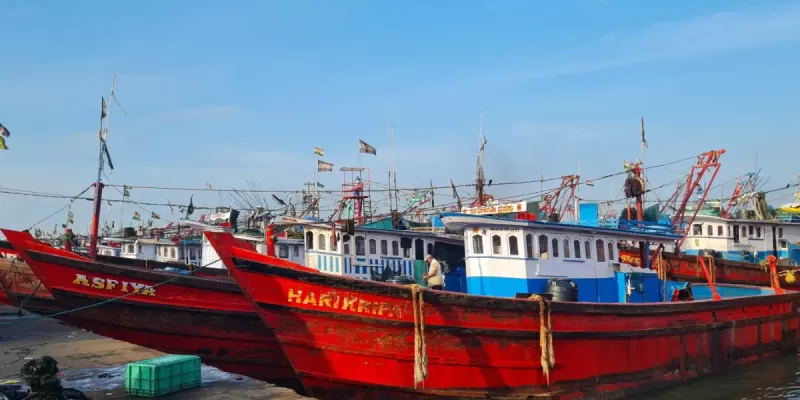
By the time most of Mangaluru is still asleep, boats are already docking at Bunder, human chains are passing crates of ice and fish hand to hand, and a marketplace that runs on decades-old rhythm and Tulu fish names is already in full motion.
Before Six, the City's Quietest Hour Is Already Loud
Mangaluru's day, for most of the city, starts somewhere around sunrise. At Bunder — the old port area around Car Street and Bunder Road, where the city's central fish market has operated for generations — it starts earlier than that. Fishing boats and deep-sea trawlers typically begin docking from around 6 to 6:30 AM, and by the time the rest of the city is stirring, the unloading is already well underway.
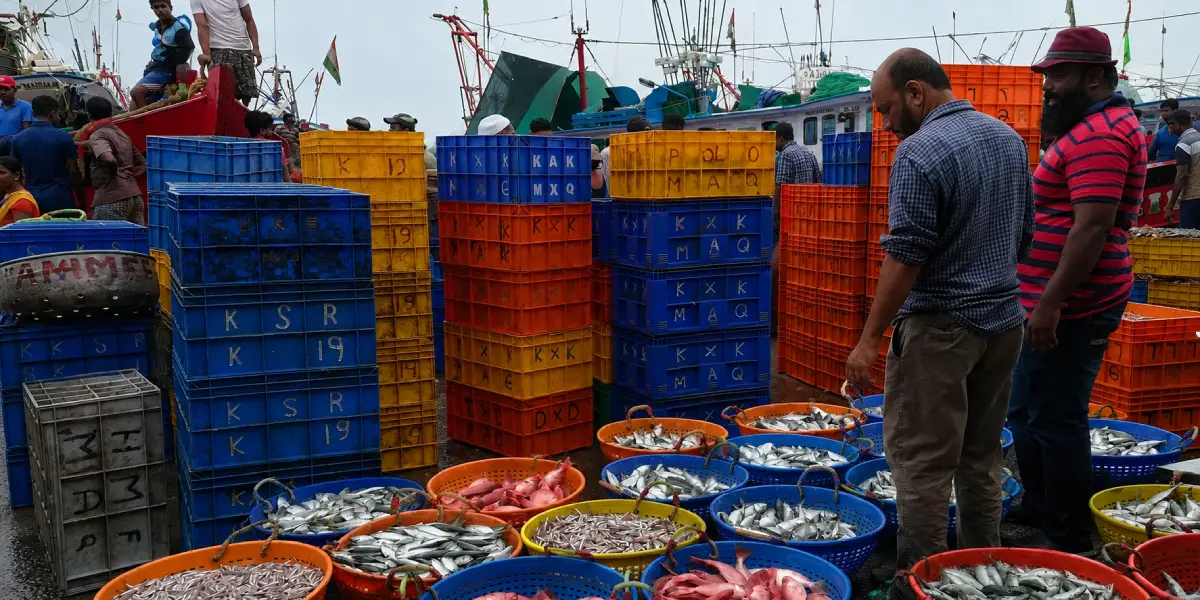
It is not a quiet process. Workers and laborers form human chains along the dock to pass crates of the night's catch from boat to shore, and more crates of ice alongside them, to keep the fish fresh through the auction and the selling that follows. Photographs of this exact scene — laborers moving crates hand to hand at what is described as Mangalore's primary fishing hub — were still being taken as recently as September 2025, which suggests this particular rhythm of the morning has not changed much even as the city around it has.
The Auction That Decides Everyone Else's Morning
Once the catch is ashore, most of it does not go straight to a stall. It goes to auction. Local traders and suppliers — some of them young, newer to the trade, others who have worked the docks for years — gather at the port each morning to bid on the boats' catch, in a process that effectively sets the day's prices and determines who gets which fish before a single customer has arrived. For the traders, it is described by those who have documented the scene as a small daily gamble: arrive early enough, judge the catch correctly, and the day's stock is secured at a workable price; misjudge it, and the margins for the rest of the day narrow considerably.
Fishing is not a minor part of Mangaluru's economy — it has long been one of the more significant sources of livelihood in the city, and the Bunder auction is the mechanism through which a large share of that livelihood gets distributed every single morning, well before most of the city has had its first cup of coffee.
A Deity of the Docks
The cultural weight of this work shows up in more than just commerce. Urwa Mariyamma, the deity particularly revered by Mangaluru's fisherfolk, is honoured with an annual feast during which her image is decorated with garlands made not of flowers, but of fish — bangude, boothai and maanji strung together in place of the more conventional offering. It is a small but telling detail about how central fishing and fish-selling are to this specific corner of the city's identity, not just its economy.
A Market That Has Long Deserved Better Infrastructure Than It Gets
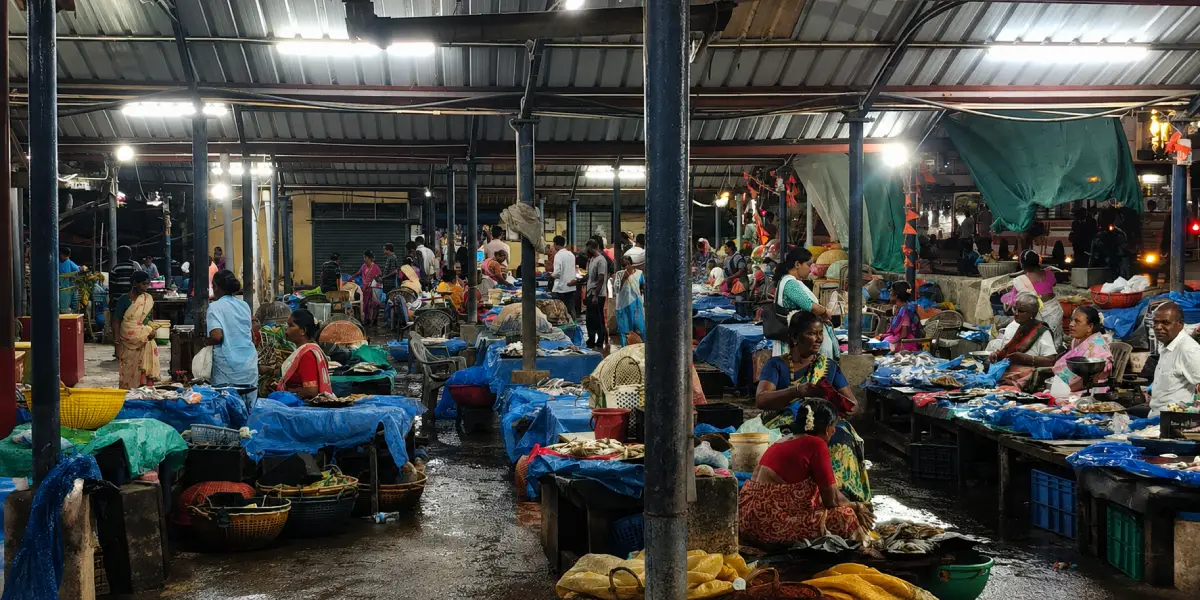
It would be incomplete to write about Bunder's fish market only in terms of atmosphere and colour. Reporting from 2016 described the central fish market near the State Bank bus terminal as serving around 250 fisher vendors out of a shelter that had fallen into serious disrepair — a weakened cement structure, rusted support poles, no functioning toilets, and open drains contributing to a persistent stench and rodent problem, with vendors telling reporters at the time that repeated appeals to local elected representatives had gone unanswered for years.
We want to be careful about how we use that reporting: it is roughly a decade old, and infrastructure can change over that time. But more recent evidence suggests the underlying conditions have not been fully resolved. A 2020 report on crowding at Bunder during the pandemic described more than 2,000 people gathering daily for unloading and auction, working without basic safety precautions, in a description of the space that did not suggest major infrastructure upgrades had taken place. And as recently as 2026, a listing for Dhakke Fish Market in Bunder — while praising the freshness and pricing of the catch — described the market's overall facilities as "limited and not modern," noting only basic provisions like separate fish-cleaning stalls and ice availability. Taken together, this points to a market that has remained functionally important to the city for decades without infrastructure investment keeping pace with that importance.
The Takeaway
Long before Mangaluru's offices open, its hospitals change shift, or its cafes start serving filter coffee, Bunder has already run through an entire economic cycle — boats docking, crates changing hands, an auction deciding the day's prices, and stalls being stocked for the customers who will arrive hours later with no idea any of it happened. It is one of the city's oldest daily rituals, run largely by people whose names rarely make it into any account of Mangaluru's economy, working in a space that has been asking for better facilities for at least a decade. The next time fish shows up on a Mangaluru dinner table, it is worth remembering how many hands, and how many hours before sunrise, it took to get there.


0 Comments
Leave a Comment