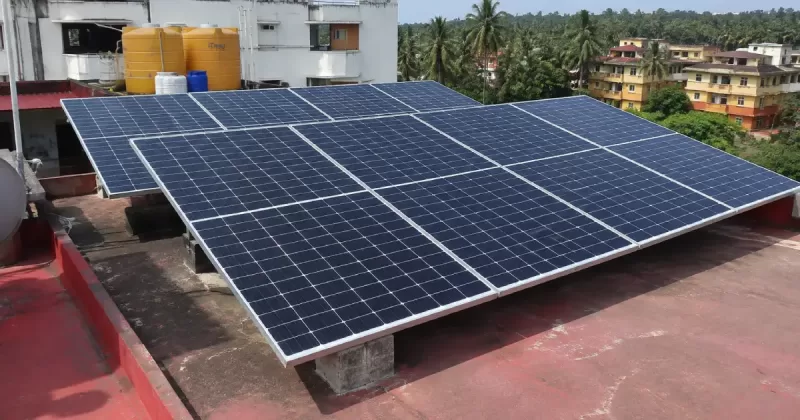
Before you sign up with an installer, here is what the subsidy actually pays, what size system your bill needs, how solar holds up through Mangaluru's monsoon, and what to check before choosing who installs it.
Solar salespeople will tell you it pays for itself in three years. Your neighbour will tell you it stopped working properly the monsoon after installation. Both of those things can be true, depending entirely on how the system was sized, mounted and maintained. Here is the version of this decision that skips the sales pitch.
1. The PM Surya Ghar Subsidy, Explained Clearly
The central government's rooftop solar scheme, PM Surya Ghar: Muft Bijli Yojana, launched on February 13, 2024, is the subsidy nearly every Mangaluru homeowner going solar today will apply under. It works as a direct benefit transfer (DBT), credited straight to your bank account, not as an upfront discount from the installer.
PM Surya Ghar Subsidy Slabs
 A few details matter more than the headline number:
- The subsidy is capped at ₹78,000, regardless of how much larger than 3 kW your system is. Installing 5 kW does not get you more subsidy than installing 3 kW.
- Panels must be ALMM-listed (on the government's Approved List of Models and Manufacturers), and installation must go through an MNRE-empanelled vendor. Non-compliant panels fail inspection and forfeit the subsidy entirely.
- System size cannot exceed your sanctioned electricity load with MESCOM. If your proposed system is larger than your sanctioned load, you will need a load-enhancement application first.
- Payment typically takes 30 to 45 days after MESCOM completes inspection and commissioning, not from the date of installation.
- In Karnataka, MESCOM (Mangalore Electricity Supply Company) is the DISCOM handling net metering and subsidy processing for Mangaluru and Dakshina Kannada, under Karnataka Electricity Regulatory Commission (KERC) regulations. Applications are made through MESCOM's SRTPV (Solar Rooftop Photovoltaic) online portal.
- Karnataka does not currently stack an additional state-level subsidy on top of the central one, unlike a few other states; the ₹78,000 central subsidy is the primary benefit available to Mangaluru homeowners.
The subsidy is real money, but it's disbursed after commissioning, not before — budget for the full cost upfront and treat the subsidy as a refund, not a discount.
2. What System Size Do You Actually Need?
The most common sizing mistake is picking a system size because a neighbour has one, rather than because of what your own electricity bill says. The starting point should always be your average monthly unit (kWh) consumption, visible on your MESCOM bill.
Matching System Size to Your Monthly Electricity Bill
| Approx. Monthly Bill | Approx. Monthly Units | Recommended System Size | Approx. Cost Before Subsidy | Subsidy | Approx. Net Cost |
|---|---|---|---|---|---|
| ₹600–900 | 100–150 units | 1 kW | ₹65,000–₹85,000 | ₹30,000 | ₹35,000–₹55,000 |
| ₹1,200–1,600 | 200–250 units | 2 kW | ₹1.3–1.6 lakh | ₹60,000 | ₹70,000–₹1 lakh |
| ₹1,800–2,400 | 300–350 units | 3 kW | ₹1.8–2.1 lakh | ₹78,000 | ₹1–1.3 lakh |
| ₹2,800–3,600 | 450–550 units | 4-5 kW | ₹2.6–3.8 lakh | ₹78,000 (capped) | ₹1.8–3 lakh |
| ₹4,500 and above | 650+ units | 6-8 kW | ₹4–5.5 lakh | ₹78,000 (capped) | ₹3.2–4.7 lakh |
A rule of thumb for Mangaluru specifically: because of the region's cloud cover during the monsoon months, a reasonable planning assumption is that each 1 kW of installed capacity generates roughly 100 to 120 units per month on average across the year, somewhat lower than the 120 to 150 units per kW often quoted for drier, sunnier parts of Karnataka. Sizing your system slightly larger than the bare minimum, rather than exactly to your average bill, helps offset the weaker generation months between June and September.
Best for: Rather than target 100% bill elimination, many homeowners size for 70–90% offset. This avoids over-investing in a system that exports most of its extra generation for comparatively modest export tariff credit.
3. Solar in Mangaluru's Monsoon and Coastal Climate
This is the part most generic solar guides skip, and the part that determines whether your system is still working well in year seven.
The monsoon dip is real, but manageable. Mangaluru's rainy season runs roughly from May or June through October, with July typically the wettest month and among the cloudiest anywhere in coastal Karnataka; sunshine can drop to under two hours a day in July, compared to around ten hours a day in January. On heavily overcast monsoon days, generation can fall to roughly 10–25% of a clear-day output. Annually, though, the loss is more modest than it feels in July, since the dry months from November to May, with their long, largely cloud-free days, make up much of the difference.
Salt air is the bigger long-term risk, not the rain itself. Mangaluru's coastal location means humid, salt-laden air year-round, not just during the monsoon. Left unaddressed, this leads to corrosion in three specific places: mounting frames and racking, nuts, bolts and fasteners, and electrical junction boxes and connectors. Panels themselves are usually the last thing to fail; the mounting hardware and electrical fittings typically fail first.
What this means practically for a Mangaluru installation:
- Ask for hot-dip galvanised or anodised aluminium mounting structures, not plain mild steel, and avoid direct contact between dissimilar metals (such as stainless steel bolts on aluminium racking) without proper isolation, which triggers galvanic corrosion.
- Look for panels with IEC 61701 salt-mist corrosion certification, a specific test standard for coastal and marine environments, not just the standard IEC certifications.
- Ensure junction boxes and connectors are properly sealed (adequate IP rating) against moisture ingress, since electrical failures in humid conditions usually start here.
- Budget for cleaning every one to three months, more frequently than an inland installation would need, since salt deposits and monsoon grime both reduce output if left to accumulate.
- Get the mounting structure engineered for monsoon wind loads, not just weight; heavy rain in Mangaluru often comes with strong gusts, and a poorly anchored structure is a bigger risk than the rain itself.
None of this makes solar a bad fit for Mangaluru. It means the difference between a system that performs well for 25 years and one that needs expensive hardware replacement after five comes down almost entirely to component choice and installation quality, not the weather itself.
Buyer Checklist Before Choosing an Installer
Before signing anything, run every installer through this list.
Solar Installer Buyer Checklist for Mangaluru Homes
| # | Check | Why It Matters |
|---|---|---|
| 1 | Is the installer MNRE-empanelled for the PM Surya Ghar scheme? | Required for subsidy eligibility; non-empanelled vendors cannot process your DBT claim |
| 2 | Are the proposed panels on the current ALMM list? | Non-ALMM panels fail DISCOM inspection and forfeit the subsidy entirely |
| 3 | Do panels carry IEC 61701 salt-mist certification? | Confirms suitability for Mangaluru's coastal, salt-laden air |
| 4 | Is the mounting structure hot-dip galvanised or marine-grade aluminium? | Reduces corrosion risk from humidity and salt over the system's lifetime |
| 5 | Does the quote separate panel, inverter, mounting and BOS costs? | Prevents hidden markups bundled into a single lump-sum figure |
| 6 | What is the workmanship warranty, separate from the panel/inverter warranty? | Panel warranties (often 25 years) don't cover poor installation; workmanship warranties typically run 5–10 years |
| 7 | Has the installer completed coastal Dakshina Kannada or Udupi installations before? | Local experience with monsoon wind loads and salt exposure is not optional here |
| 8 | Will they handle the MESCOM net metering and subsidy paperwork? | A significant share of subsidy applications get delayed or rejected over paperwork issues, not equipment issues |
| 9 | Is an Annual Maintenance Contract (AMC) offered, including panel cleaning? | Coastal systems need more frequent cleaning and inspection than inland systems |
| 10 | What is the after-sales response time for faults? | A system down for weeks during monsoon loses more generation than one serviced promptly |
Getting three quotes and running each one through this exact list, rather than comparing only the final price, is the single most effective way to avoid a system that looks good on the invoice and struggles by its third monsoon.
The Bottom Line
Solar in Mangaluru works, and the subsidy math is genuinely favourable: a well-sized 3 kW system can come down to roughly ₹1 to ₹1.3 lakh after the ₹78,000 PM Surya Ghar subsidy, typically paying for itself within four to six years given the region's somewhat lower generation compared to drier parts of Karnataka. The decision that actually determines whether that math holds up isn't the subsidy, it's whether the installer treated Mangaluru's coastal climate as a design requirement, or as an afterthought.
FAQ
How much subsidy can I get for solar panels in Mangaluru under PM Surya Ghar?
You can receive up to ₹78,000: ₹30,000 per kW for the first 2 kW (₹60,000 total) and ₹18,000 per kW for the next 1 kW, capped at ₹78,000 for systems of 3 kW or larger.
Is the PM Surya Ghar subsidy given upfront or after installation?
It is paid after installation, as a Direct Benefit Transfer (DBT) to your bank account, typically 30 to 45 days after MESCOM inspects and commissions your system.
What size solar system do I need for my Mangaluru home?
It depends on your average monthly electricity consumption. As a general guide, a 1 kW system suits bills around ₹600–900/month, 2 kW suits ₹1,200–1,600, 3 kW suits ₹1,800–2,400, and larger homes with bills above ₹2,800 typically need 4 kW or more.
Does the monsoon significantly reduce solar output in Mangaluru?
Daily output drops noticeably on heavily overcast days in July and August, sometimes to 10–25% of a clear-day output, but the annual impact is more modest because the long, sunny months from November to May offset much of the seasonal dip.
Do solar panels corrode faster in Mangaluru because it's coastal?
The panels themselves are usually the last component to fail. Mounting hardware, fasteners and electrical connectors are more vulnerable to salt-air corrosion if they aren't marine-grade or properly sealed, which is why installer and component choice matters more in Mangaluru than inland.
Which DISCOM handles solar net metering in Mangaluru?
MESCOM (Mangalore Electricity Supply Company) handles net metering, subsidy processing and rooftop solar applications for Mangaluru and the rest of Dakshina Kannada, under KERC regulations.
What should I check before hiring a solar installer in Mangaluru?
Confirm they are MNRE-empanelled, use ALMM-listed and salt-mist certified panels, offer a separate workmanship warranty, have prior coastal installation experience, handle MESCOM paperwork, and offer an AMC that includes regular panel cleaning.


0 Comments
Leave a Comment