The Farmer Who Built an Empire for Other Farmers: The Story of Varanashi Subraya Bhat
How a Class 10 dropout from a small Dakshina Kannada village turned a falling areca nut market into CAMPCO, one of India's biggest farmer cooperatives.
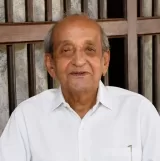
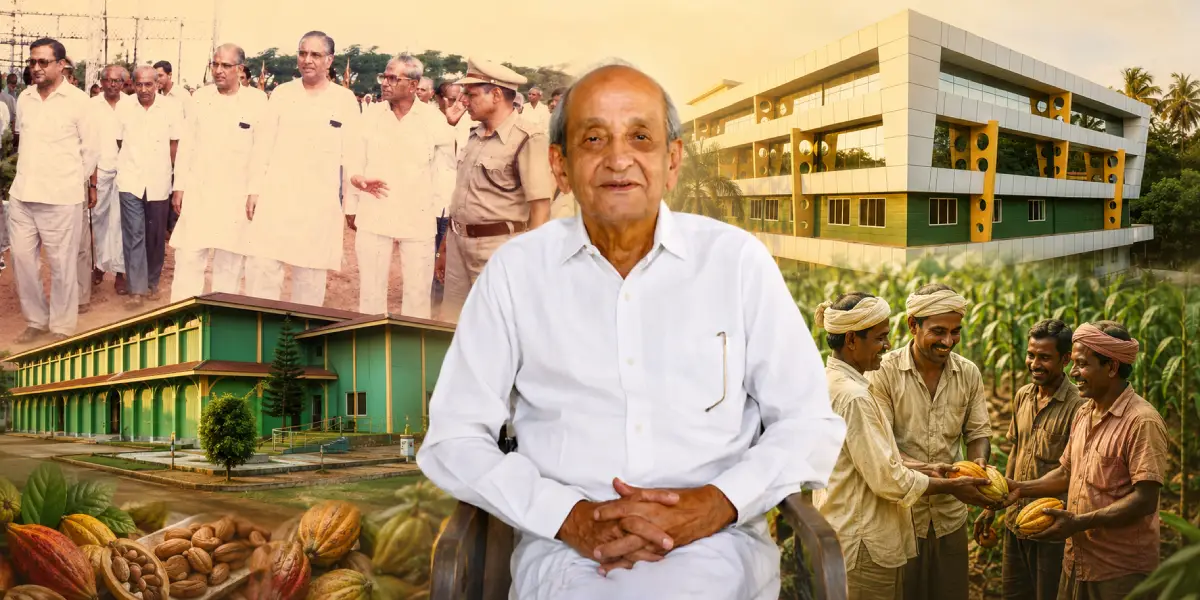
He Grew Up in a Village Where Areca Nut Was Everything
In the little settlement of Moodambail, near Adyanadka village in Dakshina Kannada, areca nut was not just a crop. It was the difference between a family eating well and a family struggling to get by.
Varanashi Subraya Bhat was born here on 8 June 1927, the son of Varanashi Krishnayya and Thirumaleshwari Amma. Money was tight at home. He studied up to matriculation at Raja's High School in Neeleshwara, across the border in Kerala, but financial constraints meant he could not continue his studies further.
So the young Subraya Bhat did what most sons in farming families did back then. He went back to the soil. He worked alongside his father, who was also serving as the local panchayat president, and slowly began learning how villages and cooperatives actually functioned.
He had no college degree. What he had instead was a front-row seat to how badly the areca nut farmer was being treated by the market.
A Village Boy Enters Public Life
By 1949, barely into his twenties, Bhat had already founded the Adyanadka Vidya Vardhaka Sangha, a body that would go on to upgrade a primary school into a full high school and junior college for village children. Education, even without one for himself, stayed close to his heart throughout his life.
In 1967, he was elected Director of the South Kanara Agriculturists Co-operative Marketing Society (SKACMS), and later became its President. Around the same period, he rose to become Chairman of the local Agricultural Produce Marketing Committee, and later a member of the Karnataka State Agricultural Marketing Board.
Piece by piece, without any formal training in economics or administration, he was building the exact experience he would need for what came next.
When Areca Nut Prices Collapsed, Farmers Turned to Him
Between 1970 and 1973, the price of areca nut crashed. Farmers across Karnataka and Kerala, who depended entirely on this one crop, found themselves at the mercy of middlemen who controlled pricing, transport, and payment terms.
"Entry of Subraya Bhat to the co-operative field is a gain to the co-operative movement." — Ramakrishna Hegde, former Chief Minister of Karnataka
Bhat brought together areca growers from both states and pushed for a cooperative that farmers themselves would own and run. On 11 July 1973, that idea became real. The Central Arecanut and Cocoa Marketing and Processing Cooperative Limited, known to everyone simply as CAMPCO, was registered in Mangalore.
It began with just five procurement centres. Farmers could now sell directly to their own cooperative, cutting out the middlemen who had controlled the trade for decades.
Bhat served as CAMPCO's President from its inception until the end of December 1990, a stretch of roughly seventeen years during which the cooperative grew from a first response to a crisis into a permanent institution.
From Areca Nut to Chocolate
CAMPCO's second big turning point came through cocoa, which farmers had started growing as an intercrop alongside their areca palms. Until 1980, a private chocolate company was the main buyer of this cocoa. When it suddenly stopped purchasing during peak harvest season, cocoa farmers were left stranded, and some even began cutting down their cocoa plants in frustration.
Bhat's answer was direct. If there was no reliable buyer for the region's cocoa, CAMPCO would become one.
On 1 September 1986, CAMPCO opened a modern chocolate factory at Puttur. The then President of India, Giani Zail Singh, inaugurated it, and the ceremony was broadcast live on Doordarshan, a rare honour for a rural cooperative venture at the time. The factory went on to become one of the largest of its kind in South India, and CAMPCO chocolate would later be produced both under its own brand and for Nestlé India.
A Legacy Measured in Crores, and in Something Harder to Count
Numbers tell part of the CAMPCO story. According to its 2017-18 annual report, the cooperative earned a profit of ₹41.72 crore on a turnover of ₹1,742 crore. By 2018-19, turnover touched a record ₹1,875 crore. Today CAMPCO runs procurement centres across Karnataka and Kerala and has extended its reach to several other Indian states.
But the harder number to count is how many farming families in Coastal Karnataka stopped being at the mercy of a middleman because of what Bhat built.
Beyond CAMPCO, he served as President of the All India Arecanut and Cocoa Growers' Association, Chairman of the Cocoa and Arecanut Development Committee under the Union Ministry of Agriculture, and as a Member of the Western Ghat Development Commission under the Ministry of Planning. Locally, as President of Punacha Panchayat, he pushed through village roads, culverts and bridges, and helped upgrade three primary schools to upper primary status.
A Quiet Family Life Away from the Cooperative Boardroom
On 15 January 1951, Bhat married Saraswathi Amma of Irde village. The couple had four children — Ishwari, Rajeshwari, Krishna Moorthy and Sathya Prakash. Saraswathi Amma passed away in September 2006.
His son, Dr Varanashi Krishna Moorthy, later carried forward a different strand of his father's interests by founding the Varanashi Development and Research Foundation, along with the Varanashi Organic Farms and its associated centres, focused on sustainable agriculture.
Bhat himself passed away on 27 December 2013 at a hospital in Sullia, following a cardiac arrest. In keeping with his wishes, his eyes were donated after his death. Thousands gathered at his residence to pay their last respects, a measure of how deeply the areca nut and cocoa farming community of Coastal Karnataka had come to regard him.
CAMPCO later honoured its founder with a first-day postal cover released in 2014, and a marble bust unveiled at the Puttur chocolate factory premises in 2017. On 21 January 2018, a statue of Bhat was also inaugurated at the same factory by the then Union Minister for Commerce and Industry, Suresh Prabhu.
Two Kannada biographies have been written about his life and work — "Varanashi" by Chirantana (1994) and "Campco Brahma Varanashi Subraya Bhat" by Shankara Saradka (2018) — along with an earlier compilation of writings on him titled "Sadhane" (1983), edited by Vasantha Kumar Thalthaje.
The Takeaway
Varanashi Subraya Bhat never finished his own schooling. But he built an institution that has, for over five decades, put food, fair prices and dignity on the table for thousands of farming families across two states. That is not a small inheritance to leave behind for a boy who once counted areca nuts in a small village called Moodambail.