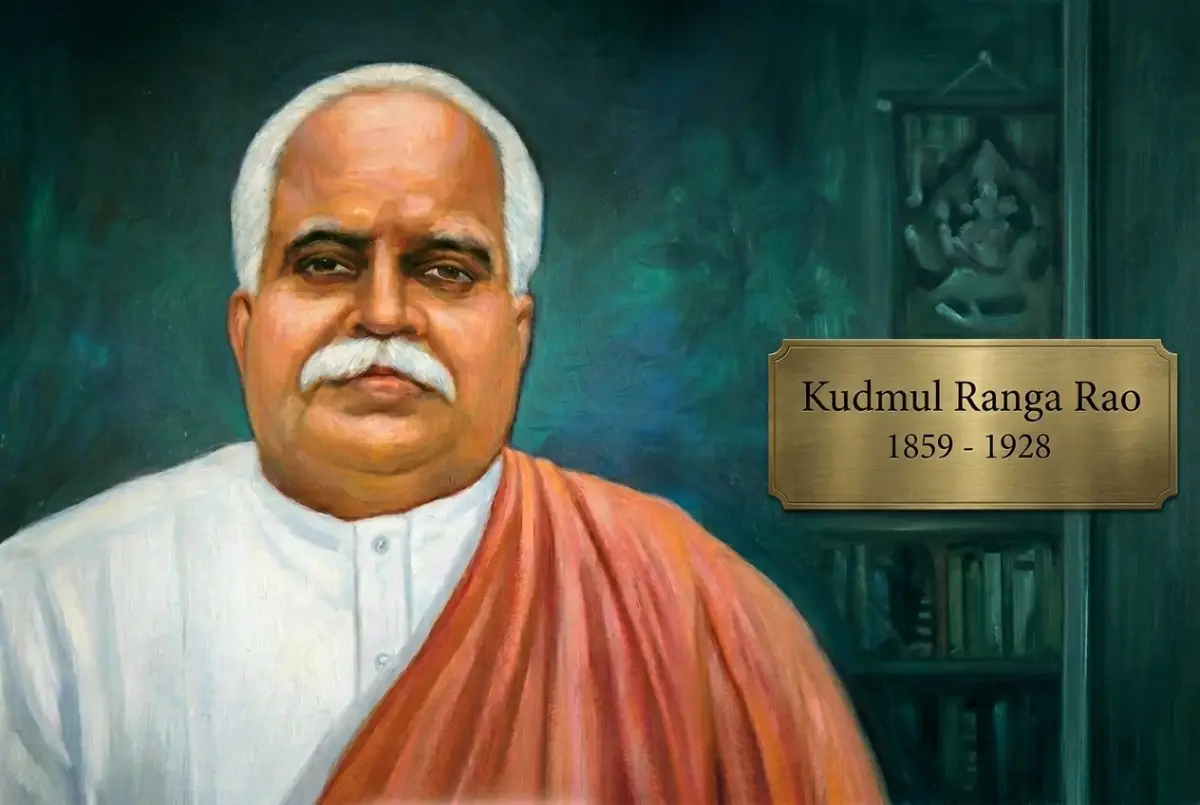
Kudmul Ranga Rao: A Revolutionary Social Reformer of Dakshina Kannada
A Man Who Chose HumLong before social justice became a national conversation, Kudmul Ranga Rao dedicated his life to uplifting the oppressed communities of Dakshina Kannada through education, dignity and reform. Known as tanity Over Social Barriers and Sparked a Quiet Revolution in Coastal Karnataka
Introduction: A Forgotten Giant of Coastal Karnataka
The history of Dakshina Kannada is filled with traders, scholars, reformers and visionaries who shaped the social and cultural identity of the region. Yet among these influential personalities, one name stands apart for his extraordinary commitment to human dignity and social equality — Kudmul Ranga Rao.
He did not command armies. He did not seek political power. Nor did he build his reputation through wealth or privilege.
Instead, he chose a far more difficult path — standing beside communities that society had pushed to the margins.
At a time when caste discrimination and untouchability were deeply entrenched in everyday life, Kudmul Ranga Rao emerged as one of the earliest and most determined social reformers of South Canara. His work in education, housing and social upliftment transformed countless lives and earned him a lasting place in the history of coastal Karnataka.
For many in Dakshina Kannada, he became more than a reformer.
He became hope.
The World Into Which Kudmul Ranga Rao Was Born
To understand Kudmul Ranga Rao’s importance, one must first understand the society of late nineteenth-century South Canara.
During British rule, South Canara — comprising present-day Dakshina Kannada, Udupi and parts of Kasaragod — was socially diverse and economically active. Mangalore was growing as an educational and commercial centre, helped by missionary institutions, expanding trade and emerging public infrastructure.
Yet beneath this progress existed severe social inequalities.
Caste divisions strongly shaped social life. Large sections of society faced exclusion from education, public spaces and economic opportunity. Communities then labelled as “Depressed Classes” or “untouchables” were subjected to humiliation and denied equal treatment.
Schools for these children were nearly non-existent. Social mobility was limited. Access to dignity itself was restricted.
It was within this unequal social landscape that Kudmul Ranga Rao began to ask uncomfortable but necessary questions.
Why should birth decide a person's future?
Why should education belong only to a few?
And why should fellow human beings live without dignity?
These questions would eventually define his life’s mission.
Early Life: From Humble Beginnings to a Larger Purpose
Kudmul Ranga Rao was born on 29 June 1859 in Kudmul village of the former South Canara region, into a Gaud Saraswat Brahmin family.
His father, Devappayya, worked as a clerk, and the family lived modestly rather than in privilege. Financial hardship touched his early life, particularly after the death of his father during his youth.
These circumstances shaped his character in profound ways.
Unlike many who might have accepted hardship as fate, young Ranga Rao pursued education with determination. He first worked as a teacher while continuing his own studies under difficult conditions. Through perseverance, he completed the necessary examinations and later qualified in law.
His rise was not one of inherited status.
It was built through effort, discipline and persistence.
This journey from struggle to professional success would later influence how he viewed poverty and exclusion. Having experienced hardship himself, he developed unusual empathy for people living on the margins of society.
The Lawyer Who Looked Beyond the Courtroom
After qualifying in law, Kudmul Ranga Rao began his legal career in Mangalore.
He quickly earned respect not merely for legal skill but for compassion.
People increasingly referred to him as the “Poor Man’s Lawyer.”
The title was not symbolic.
Ranga Rao often represented disadvantaged individuals and used his profession as a means of service rather than personal advancement alone. While many lawyers confined their work to legal disputes, he viewed law as only one tool among many for creating justice.
His courtroom experience exposed him to harsh realities.
He witnessed exploitation, unequal power structures and social discrimination operating beyond legal boundaries. He understood that while courts could settle disputes, they could not alone dismantle centuries of social prejudice.
For lasting change, society itself needed reform.
This realization marked a turning point.
Ranga Rao began moving beyond professional success toward a broader social mission that would define his legacy.
A Different Kind of Revolution Begins
Most revolutions arrive with slogans, protests or political upheaval.
Kudmul Ranga Rao’s revolution began differently.
It began with empathy.
He spent time among oppressed communities, listening to their struggles and observing the conditions under which they lived. Rather than maintaining social distance, he chose engagement.
His conviction grew steadily:
Education was the foundation of dignity and progress.
Without education, communities denied opportunity would remain trapped in dependence and exclusion.
This belief would soon inspire one of the most remarkable reform movements in the history of Dakshina Kannada.
And it would challenge the orthodox social order of the time.
The Birth of a Reform Movement
By the late nineteenth century, Kudmul Ranga Rao had reached a defining conclusion:
Charity alone could not solve inequality.
Temporary help might ease suffering, but lasting transformation required education, organization and social courage.
This conviction led to one of the earliest structured movements for oppressed communities in coastal Karnataka.
In 1897, Kudmul Ranga Rao established the Depressed Classes Mission (DCM) in Mangalore. Its purpose extended far beyond sympathy or welfare. The mission aimed to provide education, improve living conditions, secure access to drinking water and protect socially marginalized communities from exploitation.
The initiative emerged decades before untouchability became a major national movement.
For Ranga Rao, this was not political work.
It was moral responsibility.
The mission eventually became the centre of his reform activities and a turning point in the social history of Dakshina Kannada.
Education as a Weapon Against Inequality
Kudmul Ranga Rao strongly believed that social reform could not succeed unless children from oppressed communities entered classrooms.
At the time, this was a radical idea.
Children from communities then labelled as “Panchamas” or “Depressed Classes” were frequently denied admission to mainstream schools. Education remained socially restricted and economically inaccessible.
Ranga Rao decided to challenge this system directly.
He opened dedicated schools for these children across the region and called them “Panchama Schools.”
These schools were not symbolic experiments.
They represented a practical and courageous response to exclusion.
The first known Panchama school began in Urwa–Chilimbi in Mangalore in 1892, initially functioning in a modest thatched structure with only a small number of students. Additional schools gradually followed in Mangalore, Udupi, Mulki and surrounding areas.
What mattered to Ranga Rao was not the size of the school building.
It was the opening of doors that had remained shut for generations.
Schools Built on Compassion and Practical Thinking
Kudmul Ranga Rao understood a harsh truth often ignored by reformers:
Poor families could not always afford to send children to school.
For many labouring households, every child contributed to daily survival. Asking parents to prioritise education without addressing hunger or poverty would achieve little.
Ranga Rao responded with remarkable practicality.
He introduced free meals for students and even provided small monetary incentives to parents to encourage school attendance. Historical accounts note that parents were offered two paise per day to motivate families to educate their children.
Today, school meal programmes are widely accepted as social policy.
But during Ranga Rao’s era, this was an innovative and deeply humane approach.
His reform model combined compassion with realism.
Education had to become possible—not merely desirable.
This approach significantly increased enrolment and helped build trust among communities long excluded from formal education.
Breaking Social Distance
Kudmul Ranga Rao’s work was powerful not only because of what he built, but because of how he lived his ideals.
Many reformers advocated equality from a distance.
Ranga Rao crossed that distance.
Several historical accounts describe how he personally engaged with children attending Panchama schools. He sat with them, interacted closely with families and worked to remove the fear and suspicion created by generations of discrimination. Some accounts even describe him bathing children and sharing meals with them—acts considered socially unacceptable by orthodox standards of the time.
These actions carried enormous symbolic significance.
In a society structured around ritual separation and caste hierarchy, such gestures challenged prejudice at its roots.
Ranga Rao was sending a message more powerful than speeches:
Human dignity cannot be divided by birth.
Resistance from Orthodox Society
Transformative ideas rarely arrive without opposition.
Kudmul Ranga Rao’s work invited criticism from conservative sections of society that viewed caste reform as a threat to established customs.
His efforts to educate oppressed communities, oppose untouchability and interact freely across caste barriers provoked hostility. Historical records and later writings indicate that his reform activities subjected him and his family to social pressure, criticism and isolation.
But retreat was never his choice.
The resistance he faced only strengthened his resolve.
He continued opening schools, expanding outreach and mobilising support despite threats and social discomfort.
His courage lay not in confrontation for its own sake, but in persistence.
He believed society could evolve—and he was willing to endure personal cost to help that change happen.
Beyond Literacy: Building Self-Reliance
Kudmul Ranga Rao did not see education as limited to reading and writing.
He believed empowerment required livelihood, self-respect and economic independence.
Under the broader activities associated with the Depressed Classes Mission, vocational and practical training also received attention. Historical records refer to training in crafts and livelihood-oriented activities, along with residential and educational support structures developed for socially disadvantaged students.
This vision was unusually modern.
Ranga Rao understood that education without opportunity could still leave communities vulnerable.
His aim was not merely to produce literate students.
He wanted confident and self-reliant citizens.
A Quiet Revolution Across Coastal Karnataka
By the early twentieth century, Kudmul Ranga Rao’s work had begun creating visible change.
Children once denied classrooms were now entering schools.
Families previously ignored by institutions began experiencing organised support.
The reform movement spreading through Mangalore and nearby regions demonstrated that social progress could emerge from conviction, persistence and humane leadership.
This was not a revolution of headlines.
It was a revolution of classrooms, compassion and courage.
And it was only beginning.
Reform Beyond Education: Challenging Social Customs
For Kudmul Ranga Rao, education was only one part of social reform.
He believed that dignity could not flourish if society continued to imprison people within unjust customs and inherited prejudices.
During the late nineteenth and early twentieth centuries, several social practices deeply affected women and marginalized communities across India. Widowhood, especially among upper-caste Hindu communities, often carried severe restrictions and stigma. Widows faced social isolation, denial of personal freedom and limited opportunities for rebuilding their lives.
While reformers across India debated these issues, Kudmul Ranga Rao chose action over theory.
He became a vocal supporter of widow remarriage, women’s emancipation and social equality. His ideas reflected the reformist influences of the period, including currents associated with progressive movements such as the Brahmo Samaj and other social reform networks active in South India. His fight was not against faith, but against injustice carried out in the name of social custom.
Leading by Example: The Story of Radhabai
Many leaders speak about reform.
Few are willing to practice it within their own families.
Kudmul Ranga Rao chose the harder path.
His daughter Radhabai, widowed at a young age, later remarried P. Subbarayan, the Zamindar of Kumaramangalam and a future public figure in Madras Presidency politics. The marriage, solemnized in 1912, carried significance far beyond family life. It represented both widow remarriage and inter-caste reform, challenging rigid social expectations of the time.
This decision invited criticism from orthodox circles.
But for Ranga Rao, principles mattered more than social approval.
By supporting his daughter’s remarriage, he transformed reform from public speech into personal conviction. The message was unmistakable:
Social dignity must apply equally to women and men.
Radhabai herself would go on to become an influential public figure, women’s rights advocate and legislator, carrying forward the spirit of reform that shaped her upbringing. She later participated in national public life and became one of the early women associated with higher education and legislative leadership in British India.
Gandhi and Kudmul Ranga Rao
One of the most remarkable aspects of Kudmul Ranga Rao’s legacy is the respect he earned beyond coastal Karnataka.
Historical accounts and later records refer to admiration expressed by Mahatma Gandhi for Ranga Rao’s work among oppressed communities. Gandhi reportedly described him as an inspiration and guide in the upliftment of untouchables, acknowledging that Ranga Rao had begun such reform work decades earlier in South Canara.
Care must be taken while discussing such quotations because historical wording can vary across sources.
What remains historically clear is this:
Kudmul Ranga Rao’s efforts preceded Gandhi’s nationwide anti-untouchability campaigns by several decades and contributed to an early model of grassroots social reform rooted in education and lived equality.
His work was local in geography but national in spirit.
Recognition and Final Years
Kudmul Ranga Rao’s later years reflected both accomplishment and sacrifice.
By the 1920s, age and declining health had begun affecting his work. Yet the institutions he created had already taken firm root. In 1923, he entrusted the activities of the Depressed Classes Mission to the Servants of India Society, ensuring continuity beyond his lifetime. Later, several of these institutions continued under government administration and public trust structures.
The British administration recognized his public service and conferred upon him the title of Rao Bahadur.
But titles were never central to his identity.
To ordinary people, he remained something far greater:
The lawyer who stood beside the forgotten.
The teacher who opened doors.
The reformer who believed dignity belonged to everyone.
Kudmul Ranga Rao passed away on 30 January 1928.
Even in death, his ideals endured. According to documented accounts, his final wishes reflected his lifelong commitment to equality and social inclusion.
Why Kudmul Ranga Rao Still Matters Today
Modern India speaks frequently about equality, education and inclusion.
Yet Kudmul Ranga Rao was speaking about these values more than a century ago.
His message remains strikingly relevant.
He demonstrated that reform is not created through anger alone, nor through symbolism without action.
Real reform requires:
- Moral courage
- Institution building
- Empathy in action
- Long-term commitment
- Faith in education as social transformation
His schools, missions and social interventions were not temporary charity projects.
They were investments in human potential.
Across Dakshina Kannada and beyond, many continue to remember him as one of the earliest champions of Dalit dignity and educational empowerment.
His memorials, institutions and annual commemorations stand not merely as historical reminders, but as unfinished invitations to continue the work of building a more humane society.
Conclusion: A Revolution Written in Compassion
History often celebrates kings, politicians and warriors.
But societies are equally shaped by quieter revolutionaries.
Kudmul Ranga Rao belonged to that rare category.
He fought no battlefield wars.
Yet he battled fear, prejudice and inherited inequality.
He did not ask whether change would be easy.
He asked whether it was right.
And because of that conviction, classrooms opened, barriers weakened and thousands discovered opportunities previously denied to them.
The story of Kudmul Ranga Rao is not merely a chapter from Dakshina Kannada’s past.
It is a reminder for the present.
That courage can be compassionate.
That reform can begin locally.
And that one determined individual can change the moral direction of society.
MangaloreDiary Editorial Disclaimer
This feature article has been prepared for MangaloreDiary as a historical and inspirational publication based on available archival material, scholarly references, historical records and publicly accessible research sources. Every effort has been made to maintain factual accuracy and avoid fictionalization or unsupported claims. Certain historical quotations and interpretations may differ across references; therefore readers are encouraged to consult the source materials listed below for deeper study and historical context.
Referral / Research Links
- Kudmul Ranga Rao – Wikipedia
- https://en.wikipedia.org/wiki/Kudmul_Ranga_Rao
- Live History India – Kudmul Ranga Rao: A Messiah of Dalits
- https://www.livehistoryindia.com/story/eras/kudmul-ranga-rao
- Government of India – Azadi Ka Amrit Mahotsav Repository
- https://cmsadmin.amritmahotsav.nic.in/district-reopsitory-detail.htm?11993=
- Kudmul Radhabai – Historical Profile
- https://en.wikipedia.org/wiki/Radhabai_Subbarayan
- Vishwa Konkani Kendra – Kudmul Ranga Rao Hall of Fame
- https://www.vishwakonkani.org/hall-of-fame/kudmul-ranga-rao/
- Academic Research – Role of Kudmul Ranga Rao in Empowerment of Dalits in the Undivided Dakshina Kannada District
- https://pdfs.semanticscholar.org/c403/3a964f8d63f948f1e9e57b858d90ae284c7a.pdf
- Historical Repository – Kudmul Radhabai
- https://amritmahotsav.nic.in/district-reopsitory-detail.htm?26126=
0 Comments
Leave a Comment