Kamaladevi Chattopadhyay: The Mangalore-Born Woman Who Rebuilt a Nation's Crafts and Conscience
She held the Indian tricolour through a police scuffle in 1930, ran for office before most Indian women were allowed to dream of it, and then spent her later years making sure a weaver's loom in a village was never seen as less than a factory. This is the Mangalore story most of India has forgotten.
Born to a District Collector's House in Mangalore, Raised by Loss
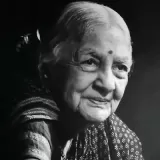
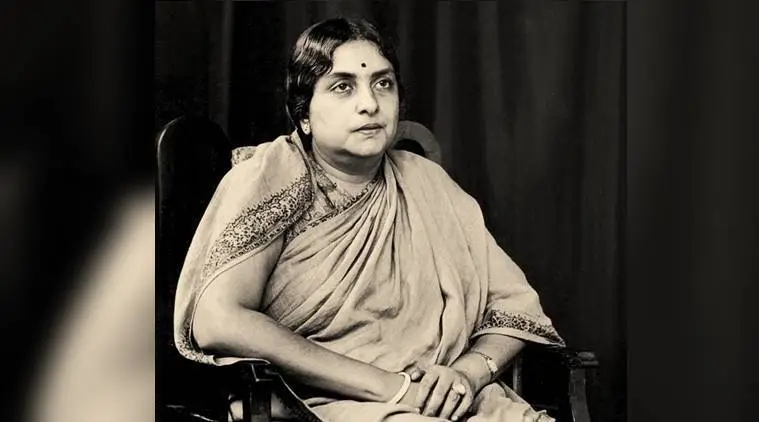
Kamaladevi Chattopadhyay was born in Mangalore on 3 April 1903, the fourth and youngest daughter of Ananthayya Dhareshwar, who served as the District Collector of Mangalore in the South Kanara district of the erstwhile Madras Presidency, and Girijabai, who came from a land-owning Chitrapur Saraswat Brahmin family of coastal Karnataka.
Her childhood was shadowed early by loss. Her father died when she was around seven, and under the inheritance customs of the time, his property passed not to his own household but to a son from his first marriage — leaving Girijabai, an educated but largely home-tutored woman, to raise Kamaladevi essentially on her own. It was, by several accounts, Kamaladevi's first close encounter with how unfairly the law could treat women, well before she had the words to name it as such.
She was raised for a time in her maternal uncle's home, a household that doubled as an informal meeting point for some of the era's leading reformers and nationalists — among them Mahadev Govind Ranade, Gopal Krishna Gokhale and Annie Besant, all friends of the family who visited often. For a girl not yet in her teens, this was an unusually direct introduction to the ideas that would define her adult life.
Widowed as a Teenager, and a Second, Braver Marriage
Kamaladevi's own first marriage came early — most accounts place it at age fourteen, following the custom of the period, though a small number of sources cite an even younger age. She was widowed within two years, still a schoolgirl.
She went on to study at St Ann's Convent in Mangalore before continuing her education at Queen Mary's College in Madras. It was there that she met a fellow student, Suhasini Chattopadhyay — the younger sister of the poet Sarojini Naidu — who introduced Kamaladevi to her brother, Harindranath Chattopadhyay, a poet, playwright and actor. Drawn together by a shared love of the arts, the two married when Kamaladevi was twenty, a decision that scandalised more conservative sections of society at the time, since widow remarriage was still widely frowned upon.
Kamaladevi and Harindranath went on to write and perform plays and skits together, and Kamaladevi herself took the unusual step, for a woman of her social standing, of acting on screen — appearing in the Kannada silent film Mrichhakatika (1931), based on the Sanskrit play by Sudraka, and later in Hindi productions including Tansen (1943), Shankar Parvati (1943) and Dhanna Bhagat (1945).
The couple later moved to London, where Kamaladevi earned a diploma in sociology from Bedford College, University of London — training that would quietly underpin much of her later work in rural development and cooperative organising.
From London Drawing Rooms to the Salt Satyagraha
It was in London, in the early 1920s, that Kamaladevi first learned of Mahatma Gandhi's Non-Cooperation Movement. She returned to India in 1923 and joined the Seva Dal, a Gandhian organisation dedicated to social upliftment, where she took charge of recruiting, training and organising women volunteers, known as Sevikas.
Her political ambitions soon outgrew grassroots organising. With encouragement from Margaret Cousins, founder of the All India Women's Conference, Kamaladevi contested a seat in the Madras Provincial Legislative Assembly in 1926 — becoming the first woman in India to stand for a legislative election. She lost, narrowly, by a margin some accounts put at around two hundred votes, but the barrier she had tested did not hold for long after her.
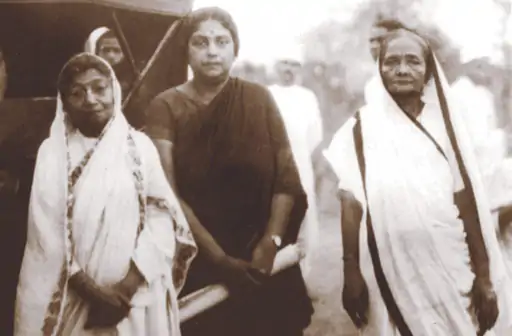 Ameena Tyabji, Kamaladevi Chattopadhyay, and Kasturba Gandhi at Sabarmati Ashram, March 1930. | Photo Credit: bhaskarenglish.in
The Woman Who Sold "Freedom Salt" at the Bombay Stock Exchange
Kamaladevi's most famous act of defiance came during the 1930 Salt Satyagraha. She was among those who urged Gandhi to formally include women in the movement's front ranks, and she led a raid on the Wadala salt depot near Bombay, becoming one of the first women arrested for violating British salt laws — reportedly the first woman arrested for this offence in the Bombay Presidency specifically. In one particularly bold episode, she walked into the Bombay Stock Exchange itself to sell packets of illegally produced "freedom salt" to stockbrokers.
She rose to wider national attention on 26 January 1930, when she held on to the Indian tricolour through a physical scuffle with colonial authorities — an image that made her, in the words of contemporaries, one of the more visible faces of the independence movement's next generation. Across her years in the freedom struggle, she was arrested and imprisoned multiple times, spending a substantial portion of the 1930s and early 1940s in and out of British jails.
In 1936, she helped organise the Congress Socialist Party alongside Jayaprakash Narayan and Ram Manohar Lohia, and went on to serve as its president. She used that platform, and every other one available to her, to push positions well ahead of her time: campaigning for the Child Marriage Restraint Bill and the Age of Consent Bill, arguing for women's right to divorce, equal pay and birth control, and publicly disagreeing with Gandhi himself over the initial exclusion of women from the 1930 Dandi March.
She opposed the 1947 Partition until the very end, voting against it within Congress's internal deliberations even as Gandhi and Nehru pressed for unity behind the decision. When Partition went ahead regardless, the scale of the resulting violence and displacement disillusioned her deeply enough that she stepped back from formal party politics altogether.
Turning Refugee Camps Into a Town: The Faridabad Story
Rather than retreat from public life, Kamaladevi redirected it. In the winter of 1947, tens of thousands of refugees from West Punjab were living in makeshift tents around Delhi's Kingsway Camp, with the cold season approaching and no serious rehabilitation plan in place.
Kamaladevi's answer was to found the Indian Cooperative Union and use it to build permanent housing on cooperative principles rather than wait for charity or government relief. What emerged from that effort was Faridabad — today a major industrial town on Delhi's outskirts — built substantially through the labour of the refugees themselves, who laid its roads, built its houses, and constructed a hospital (later named after Khan Abdul Ghaffar Khan, "the Frontier Gandhi," and known today as BK Hospital) and a school. Kamaladevi is credited with tracking down engineers, arranging government loans, and resolving disputes to keep the project moving, effectively willing an entire township into existence through sustained, unglamorous persistence rather than any single dramatic gesture.
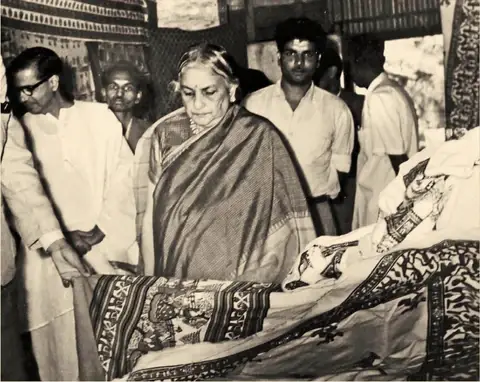 Indian handloom weaving, revived under Kamaladevi Chattopadhyay's leadership. | Photo credit : Delhi Crafts Council
Reviving What Colonial Rule Had Nearly Erased
If the freedom struggle was the first half of Kamaladevi's public life, the revival of India's traditional crafts and performing arts was unmistakably the second, and arguably the half for which she is best remembered today, even if imperfectly.
She was instrumental in setting up the All India Handicrafts Board and served as its first chairperson, by some accounts for as long as seventeen years. She is widely credited as the driving force behind the Central Cottage Industries Emporia set up across the country, and she helped establish the Delhi Crafts Council, the Crafts Council of India, and the World Crafts Council, going on to serve as the first president of the World Crafts Council's Asia Pacific Region.
Her reach extended deep into the performing arts as well. She played a founding and later leading role in the National School of Drama, chaired the Sangeet Natak Akademi, and in 1964 started the Natya Institute of Kathak and Choreography in Bangalore under the Bharatiya Natya Sangh, an organisation she had also helped establish roughly a decade earlier. In 1979, she worked with Dr Kapila Vatsyayan to found the Centre for Cultural Resources and Training (CCRT), a Ministry of Culture institution built specifically to weave Indian cultural knowledge into mainstream school education — an institution that continues to run its programmes and honour her memory through its annual Virasat Kamaladevi festival to this day.
For all of this, she came to be affectionately known in some circles as "Hastkala Maa," roughly translated as the Mother of Handicrafts, though the more commonly cited honorific in recent coverage is "Hatkargha Maa" for her handloom-specific work — the two terms appear to be used somewhat interchangeably across different sources, and we have not been able to pin down a single definitive version.
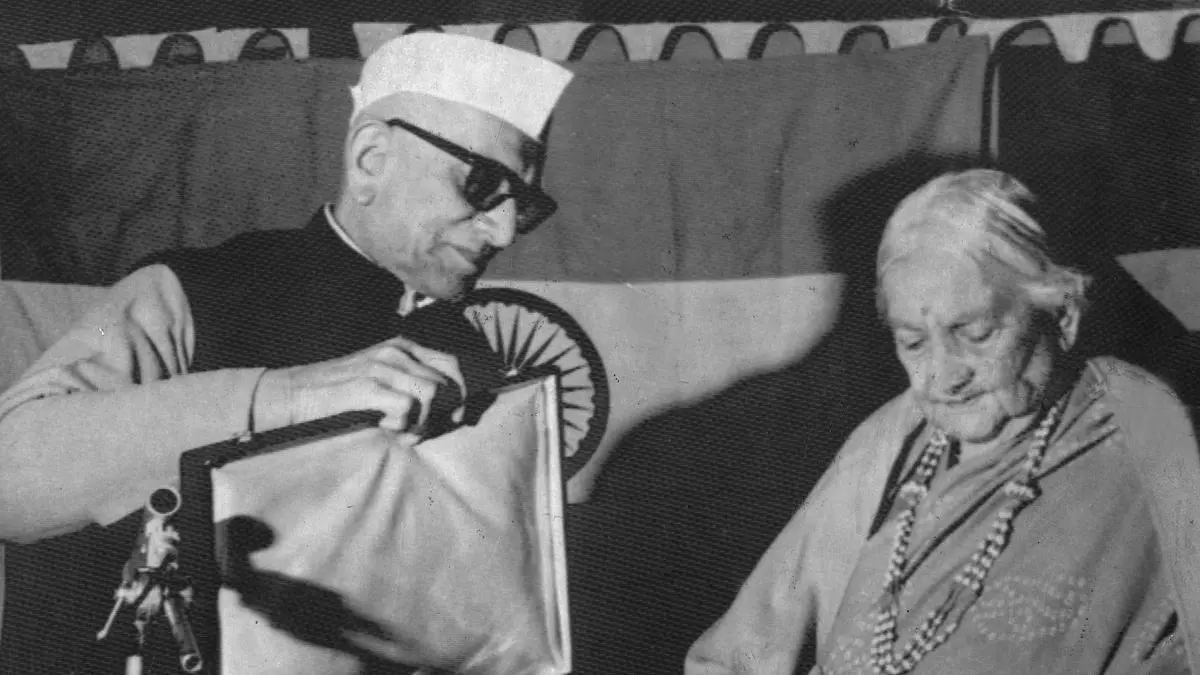 Prime Minister Morarji Desai presenting the National UNESCO Award for 1977 to Kamaladevi Chattopadhyay in New Delhi on December 18, 1977. | Photo Credit: The Hindu Archives
Recognition, Late and Considerable
Kamaladevi was awarded the Padma Bhushan in 1955 and the Padma Vibhushan in 1987, and in 1974 received the Sangeet Natak Akademi Fellowship (Ratna Sadsya), the Akademi's highest honour. In 1966, she received the Ramon Magsaysay Award for Community Leadership, with the award citation describing her as one of independent India's more broadly effective architects, credited with mobilising traditional artistry for new generations at a time when mass production threatened to submerge it.
She also received UNESCO recognition in 1977 for her contribution to promoting handicrafts, the Desikottama — Shantiniketan's highest honour — and was made a Member of Honour by UNIMA, the international puppetry organisation. In 2007, Outlook magazine included her among its list of 60 Great Indians, and India Today separately named her among its "100 Millennium People." On 3 April 2018, marking her 115th birth anniversary, Google featured her in a homepage Doodle.
When the novelist Raja Rao wrote the introduction to her 1986 memoir, Inner Recesses, Outer Spaces, he described her, in terms that have stayed attached to her name since, as one of the most distinguished women on the Indian public stage of her time — someone who moved with equal ease among the sophisticated and the ordinary, in city and countryside alike.
The Takeaway
Kamaladevi Chattopadhyay died in Bombay on 29 October 1988, at the age of 85. She is, by most honest accounts, far less remembered today than her contribution warrants — overshadowed, perhaps, by the fact that she refused nearly every political reward that came her way after independence, choosing instead to spend her later decades convincing a newly free country that a handwoven saree and a village loom were not relics to be modernised away, but living inheritances worth protecting. For a woman from a district collector's household in Mangalore who was widowed at fourteen, that is not a small thing to have insisted on, and won.