The Mukka Scientist Turning Waste Heat Into Electricity — And Into a World's Top 2% Ranking
From a quiet materials science lab at Srinivas University, Dr. U. Sandhya Shenoy has spent years chasing a question most people never think to ask — where does all that lost heat go, and could it power something instead?

The Heat Nobody Thinks About
Every factory chimney, every vehicle exhaust, every power plant cooling tower is quietly throwing away energy, all day, every day, in the form of heat that simply escapes into the air. Most of us never think about it. Dr. U. Sandhya Shenoy has built her entire research career around it.
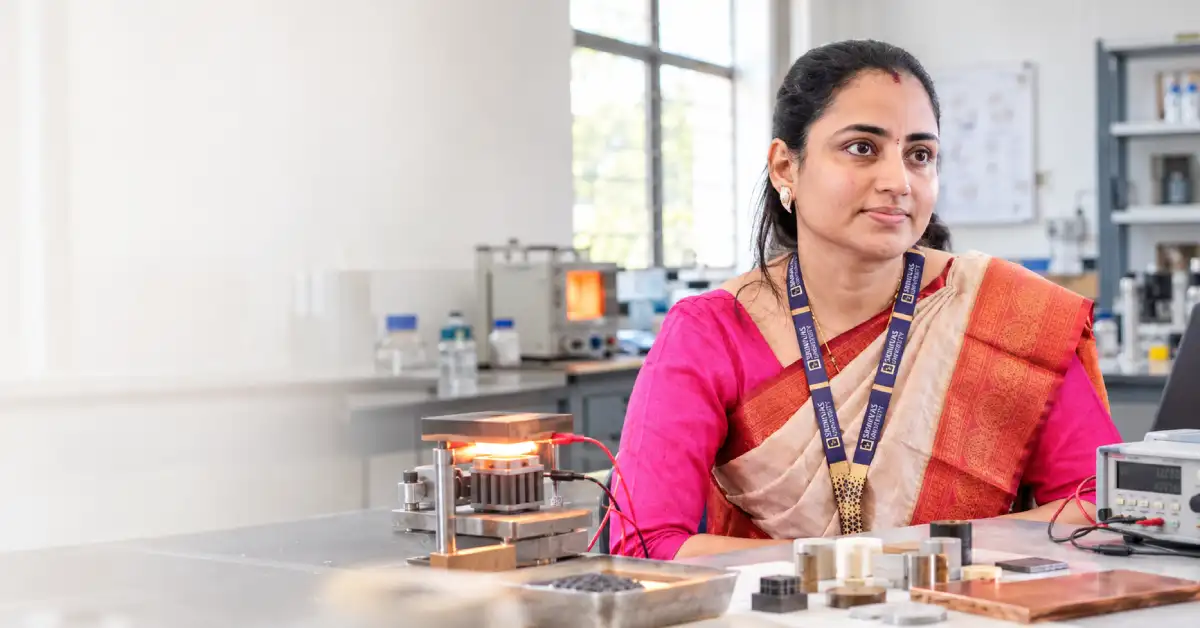
At the Institute of Engineering and Technology, Srinivas University, in the coastal town of Mukka just north of Mangaluru, Shenoy works in a field most people have never heard of — thermoelectrics — developing materials that can capture that escaping heat and convert it directly into usable electricity. No turbines, no moving parts, no combustion. Just a material, engineered at the atomic level, doing something that sounds almost like a trick: turning a temperature difference into a current.
It is unglamorous, patient, laboratory science. And for three consecutive years, it has placed her among the most cited two percent of scientists on the planet.
What It Actually Means to Be in the Top 2%
Each September, Stanford University, working with the publisher Elsevier, releases an updated version of its "Science-wide Author Databases of Standardized Citation Indicators" — a global ranking that measures scientific impact through a composite score built from citations, productivity, and scholarly influence, drawn from Scopus author profiles across every major field of research. It is widely regarded as one of the most rigorous global measures of a researcher's real-world influence, precisely because it accounts for so much more than a single highly cited paper.
In the list released on 19 September 2025, Dr. Shenoy's name appeared for the third year running — placing her, by the ranking's own definition, in the top two percent of scientists worldwide by research impact, across every discipline, not just her own.
Table: What the Stanford Top 2% Ranking Measures
| Element | Detail |
| Published by | Stanford University, in collaboration with Elsevier |
| Basis | Composite citation score (c-score), covering citations, h-index and scholarly productivity |
| Data source | Scopus Author Profiles |
| Scope | Top 100,000 scientists globally by c-score, or the top 2% within their subfield |
| Frequency | Updated annually, typically released in September |
| Dr. Shenoy's standing | Listed for three consecutive years, as of the September 2025 update |
From NITK to the Lab Bench
Dr. Shenoy's academic roots trace back to the National Institute of Technology Karnataka (NITK), Surathkal — meaning the scientist now putting Mukka on the global research map was trained, in part, just down the coast from where she now works.
Her published research record tells the story of a scientist who built her expertise working alongside some of India's leading names in materials chemistry. Several of her most cited early papers — on magnesium-alloyed tin telluride, bismuth-and-indium co-doped germanium telluride, and related thermoelectric compounds — were co-authored with researchers including Kanishka Biswas and Umesh Waghmare, whose work on these same material systems has shaped the field internationally. Those papers, published in journals including Chemistry of Materials and the Journal of the American Chemical Society, have each been cited hundreds of times — foundational contributions to how the field thinks about improving thermoelectric performance in telluride-based materials.
Today, as a DST INSPIRE Faculty researcher at Srinivas University, Shenoy's own Google Scholar profile shows more than 6,400 citations to her work — a body of research spanning thermoelectrics, photocatalysis, supercapacitors and nanofluids, all broadly united by one goal: finding materials that can do more with energy that would otherwise go to waste.
Did You Know? Dr. Shenoy's Google Scholar profile shows more than 6,400 citations to her published research — a measure of how widely other scientists worldwide have built on her work.
A Shelf of Recognitions, Not Just One Ranking
The Stanford ranking is the headline, but it sits alongside a longer list of recognition that has quietly accumulated around Shenoy's research over the past several years.
Table: Dr. Sandhya Shenoy's Key Recognitions
| Year | Recognition |
| 2021 | NASI-Young Scientist Platinum Jubilee Award, The National Academy of Sciences, India |
| 2023 | Dr. Kalpana Chawla Young Women Scientist State Award, Karnataka State Council for Science and Technology, Government of Karnataka |
| 2023–2026 | Associate, Indian Academy of Sciences |
| 2024 | SMC Medal, Society for Materials Chemistry |
| 2025 | CRS Silver Medal, for contributions to materials chemistry and innovation |
| 2023, 2024, 2025 | Stanford/Elsevier World's Top 2% Scientists listing (three consecutive years) |
Named for India's first woman astronaut, the Kalpana Chawla award in particular signals something beyond individual achievement — it recognises young women building serious scientific careers in a state actively trying to grow its research base outside the usual metros.
Why a Scientist in Mukka Matters to Mangaluru
Srinivas University, where Shenoy works, sits in Mukka — a coastal locality better known in recent headlines for the Mangaluru College of Fisheries' upgrade into a Blue Economy university than for materials chemistry breakthroughs. That proximity is not incidental. It reflects something real happening in and around Mangaluru: a coastal education belt, long associated with medicine and engineering degrees, quietly building genuine research depth in newer, less visible fields.
A globally ranked materials scientist working from a coastal Karnataka campus, rather than from an IIT or a metro research institute, matters for a specific reason: it tells regional students, and especially young women considering research careers, that serious, globally recognised science does not require leaving home. Commentary on Shenoy's recognition has repeatedly returned to this point — that her trajectory serves as a visible, local example for students weighing whether ambitious research careers are only built elsewhere.
It also matters for what her specific research area promises, if it scales. Thermoelectric materials capable of efficiently converting industrial waste heat into electricity could, in principle, make a meaningful dent in energy efficiency — for the chemical plants and industrial units in Mangaluru's own backyard, among countless other applications. Shenoy's work remains fundamentally materials research rather than deployed technology, but it sits squarely inside the kind of energy innovation India's broader clean-energy ambitions will eventually need.
What Is a Thermoelectric Material? A thermoelectric material generates electricity directly from a temperature difference, without any moving parts — making it possible, in principle, to capture energy that would otherwise be lost as waste heat from engines, furnaces and power plants.
The Quiet, Cumulative Nature of Real Science
What stands out most in the record of Shenoy's recognition is not any single award, but the repetition — three consecutive years on the same demanding global list, built paper by paper, citation by citation, without the kind of singular breakthrough moment that makes international headlines easily. It is, by its nature, unglamorous work: synthesising materials, measuring their properties, publishing results, and doing it again.
That is, in its own way, the more durable kind of achievement — the sort that keeps showing up on a rigorous, independently compiled list year after year, long after the news cycle around any one headline has moved on.
Read Next on Mangalore Diary
- Shiny Asma Saldanha: The Karkala Girl Who Turned a Childhood Fear of Flying Into Udupi District's First Woman Commercial Pilot
- Why Mangalore Became India's Unlikely Medical Hub
- Is Mangaluru Becoming Karnataka's Next Technology Hub?
FAQ
Q: Who is Dr. Sandhya Shenoy?
A: Dr. U. Sandhya Shenoy is a Professor and Principal Research Scientist in the Department of Materials Science and Engineering at the Institute of Engineering and Technology, Srinivas University, Mukka, near Mangaluru. Her research focuses on thermoelectric materials that convert waste heat into electricity.
Q: What does "top 2% scientists" actually mean?
A: It refers to a global ranking published annually by Stanford University and Elsevier, based on a composite citation-impact score (c-score) calculated from Scopus author data. Being listed places a researcher among the top 2% most-cited scientists worldwide, or within their subfield.
Q: How many times has Dr. Shenoy been included in this ranking?
A: As of the most recent publicly available update (September 2025), she has been included for three consecutive years.
Q: What are thermoelectric materials used for?
A: They convert a temperature difference directly into electricity with no moving parts, making it possible to capture and reuse heat that would otherwise be wasted from sources like industrial processes, engines and power plants.
Q: Where did Dr. Shenoy study?
A: Her education includes the National Institute of Technology Karnataka (NITK), Surathkal, according to her publicly listed professional profile.
Q: What other awards has Dr. Shenoy received?
A: Her recognitions include the NASI-Young Scientist Platinum Jubilee Award (2021), the Dr. Kalpana Chawla Young Women Scientist State Award (2023), Associate status at the Indian Academy of Sciences (2023–2026), the SMC Medal (2024), and the CRS Silver Medal (2025).