There's a particular kind of guilt that comes with writing this post.
Every time someone publishes a "hidden gem" beach guide in India, they set a timer. Give it two monsoon seasons, maybe three — and that quiet stretch of sand you loved precisely because it had no one on it will have a bhutta stall, a selfie point, and a queue for parking on Sundays. The coast of Karnataka is not immune to this.
So I'll say this upfront: these beaches are real, they're genuinely quiet right now, and they deserve to be treated with more respect than the average tourist brings to Panambur on a long weekend. Go carefully. Leave nothing. Tell fewer people than you want to.
That said — you should know they exist.
Why Mangalore's Coast Is Different From Goa's
Before we get to the list, a word about what makes this coastline worth your time.
The Karnataka coast is not trying to be Goa. It doesn't have Goa's infrastructure, Goa's nightlife, or Goa's international airport. What it has is 320 kilometres of coastline where rivers — the Netravati, Gurupura, Shambhavi, Nandini, Souparnika, Suvarna — constantly meet the Arabian Sea, creating estuary beaches that are geographically unlike anything on the Konkan coast to the north.
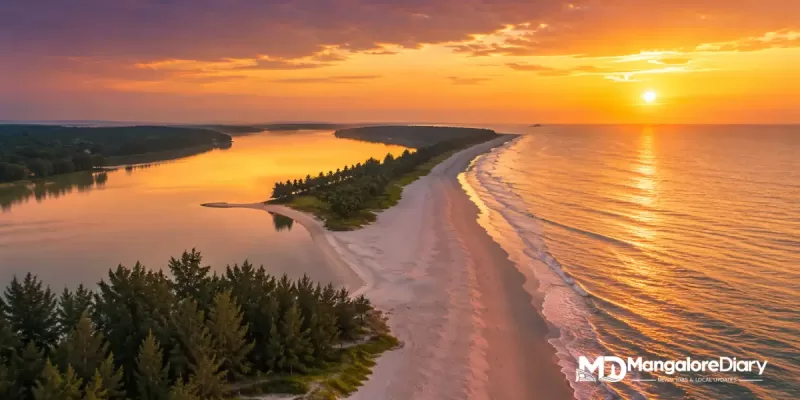
At these river-meets-sea points, you get something rare: calm backwater on one side, open ocean on the other, a thin strip of sand in between, and usually — for now — almost nobody else around.
That's the coastal Karnataka formula. And once you've experienced it, a regular beach starts to feel incomplete.
Beach 1 — Sasihithlu: The Surfer's Secret
Distance from Mangalore: ~22 km north via NH-66 Best time to visit: October to February Crowd level: Low on weekdays; moderate during surf festival season
Located where the Shambhavi and Nandini rivers meet the Arabian Sea, Sasihithlu is a uniquely beautiful beach with an island-like feel — a narrow strip of land between the river mouth and the open sea.
Walk through the village to reach it, past an avenue of acacia trees that opens suddenly onto white sand and blue water. The approach alone is worth the trip.
Sasihithlu has hosted the All Cargo Indian Open of Surfing, putting it on the global surfing map. The river delta viewpoint — where the Shambhavi and Nandini rivers converge with the Arabian Sea — is the beach's most photographed spot.
What makes it special for the non-surfer: the beach remains remarkably quiet on non-event days. The backwaters on one side make it ideal for early morning birdwatching. The white sand is genuinely clean. There are no large commercial food stalls — bring your own snacks, which is honestly part of the charm.
What nobody tells you: There's a small entry fee (around ₹20 per person) at the gated main entrance. A sea walk now exists but may have restricted access depending on the season — check before going.
Don't miss: Arrive by 6:30 AM for the sunrise over the backwaters. Stay for the surf watch if you're visiting November–February.
How to get there: Take NH-66 north from Mangalore. Deviation near Haleyangadi leads through Sasihithlu village to the beach. Buses (routes 2, 2A) from State Bank bus stop also cover this route.
Beach 2 — Someshwara: Rocks, Ruins, and Rough Seas
Distance from Mangalore: ~10 km south, near Ullal Best time to visit: October–March; sunset visits are exceptional Crowd level: Very low — "undiscovered by tourists" as Karnataka Tourism describes it
Someshwara Beach is famous for its natural beauty, tranquility, and the iconic Rudra Shile — a large cluster of black rocks visible at low tide, believed to be the spot where the great Sage Sukadeva meditated.
The rocks are the thing here. Rudra Shile — "rocks of Lord Shiva" — are dramatic, black, massive, and photogenic in a way that softer sandy beaches simply aren't. At high tide, waves crash against them in a display that's genuinely awe-inspiring and mildly terrifying. Photographers know this beach exists. Casual tourists largely do not.
The Someshwara Temple adjacent to the beach was built during the Alupa dynasty in the 10th century and is a popular pilgrimage site. From the nearby Ottinene hillock, visitors can get panoramic views of the Netravati River winding its way to the sea through mangroves.
Honest caveat: The sea here is very rough with large waves — unsafe for swimming. The access road to the beach is through relatively narrow roads, and commercial facilities are very limited. This is a beach for watching, not swimming. Bring water.
Best shot: Stand near Rudra Shile at 5:30 PM when the western light turns everything copper. The rocks, the waves, and the temple in the frame — it photographs like something from another century.
How to get there: Buses from Mangalore to Ullal, then towards Someshwara bus stand. The beach is about 500 metres from the bus stand. Autos available from Ullal.
Beach 3 — Talapady: The Border Beach
Distance from Mangalore: ~15 km south, on the Karnataka–Kerala border Best time to visit: November to March Crowd level: Minimal — mostly local families and couples
Talapady is technically the last beach in Karnataka before you cross into Kerala. That border geography gives it a particular quality — neither state has fully claimed it for tourism, which means it remains clean, uncrowded, and genuinely peaceful.
Tripadvisor reviewers describe it as "a superb place for enjoying the beauty of sea, clean and well-maintained, not so much spoilt by overcrowding."
The sand at Talapady is darker than Panambur — which means it's better for long walks. The stretch is wide and long enough that even on weekends, you can find space to yourself. There are no major commercial stalls, but a few local tea shops operate nearby.
What makes it different: The drive down to Talapady — particularly if you take the coastal road through Ullal rather than the highway — is half the experience. You pass fishing villages, small temples, and stretches of road flanked by the sea on one side and dense coastal vegetation on the other.
Good for: Couples, solo walkers, photographers wanting an uncrowded evening beach without driving far from Mangalore city.
How to get there: NH-66 south from Mangalore through Ullal. Approximately 30–40 minutes by car or auto.
Beach 4 — Kodi Bengre (Delta Beach): Water on Three Sides
Distance from Mangalore: ~70 km north near Kundapura, Udupi district Best time to visit: October to February Crowd level: Very low; the drive filters casual visitors naturally
Surrounded by water on three sides, Kodi Bengre Beach sits where the Suvarna River drains into the Arabian Sea, forming a delta — hence its other name, Delta Beach. It is also known as a 'sangama' point and has a small port for fisheries.
The approach to Kodi Bengre is unlike any other beach road in Karnataka. You drive along a thin strip with the river on your right and the Arabian Sea on your left — water on both sides, simultaneously, for several kilometres before you reach the delta point. It's the kind of road that makes you stop the car and just look.
At the tip — the actual delta point — water surrounds you on three sides. It gives you the rare feeling of standing at the edge of the world, with the freshest seafood thalis available at tiny local huts in pure ghar-ka-khana style: just-caught fish, red rice, and coconut curry.
Important note: The beach waters here are not suitable for swimming — sinking sands pose serious risks. This is strictly a landscape and seafood beach. Wear good footwear as reaching the actual beach requires climbing down a few rocks.
Best for: Landscape photography, drone operators, seafood lovers, and anyone who wants to feel genuinely at the edge of the land.
How to get there: NH-66 north from Mangalore to Kundapura (approximately 70 km), then local roads to Kodi Bengre village. From Udupi, it's about 17 km via local roads.
Beach 5 — Maravanthe: India's Most Dramatic Beach Road
Distance from Mangalore: ~85 km north near Kundapura Best time to visit: November to February (year-round access, but avoid monsoon for driving) Crowd level: Low on weekdays; growing Instagram attention — visit mornings
Maravanthe Beach stands out for its extraordinary geography: on one side, the Arabian Sea stretches endlessly, while on the other, the calm Souparnika River meanders gracefully. NH-66 runs between the two, creating an iconic scenic stretch often described as one of India's most picturesque drives.
This is the beach most at risk of "going viral" among the beaches on this list. The road-between-two-water-bodies visual is genuinely extraordinary — it photographs well, it drone-videos better, and it's exactly the kind of place that travel reels are made of.
What makes it special beyond the visual is its rare natural structure: the shoreline is unusually straight, allowing uninterrupted horizon views, and local fishing boats remain active at specific hours, giving visitors a chance to observe traditional fishing practices without commercial set-ups.
The Kodachadri Hills visible in the background on clear days complete a picture that really does look almost unreal.
Go in the morning. The afternoon light is harsh and the NH-66 truck traffic builds up. An early morning drive between 6–8 AM, when the mist is still lifting off the Souparnika and the sea is glassy, is one of the most beautiful drives in South India.
How to get there: NH-66 north from Mangalore through Kundapura. Maravanthe is well-signposted on the highway — you genuinely cannot miss it if you're driving this route.
Beach 6 — Padubidri: The Blue Flag You've Never Heard Of
Distance from Mangalore: ~35 km north, Udupi district Best time to visit: October to March Crowd level: Low; families and local visitors only
Padubidri is one of the few beaches in India to hold the prestigious Blue Flag certification — awarded only to beaches meeting strict international standards for cleanliness, safety, and water quality. Despite these credentials, it remains far calmer and more personal than the busy Mangalore city beaches.
Blue Flag certification means lifeguards on duty, tested clean water, and maintained facilities. This is the beach to take children to if you're staying in Mangalore for a few days and want a safe, clean option that isn't Panambur on a weekend.
The fact that most Mangaloreans haven't heard of Padubidri's Blue Flag status is a small civic embarrassment. A beach holding India's highest international cleanliness certification should be famous. It isn't. That's your opportunity.
How to get there: NH-66 north from Mangalore, approximately 35 km. Local buses from Udupi city also connect here.
A Note on Going to These Beaches Responsibly
I want to be direct about something.
These beaches are quiet because they haven't been commercialised. The moment that changes — the moment "secret beach near Mangalore" becomes a searchable address with parking lots and bhutta carts — they stop being what made them worth visiting in the first place.
Bring your own food and water to beaches that don't have stalls. Take your plastic back. Don't fly drones over active fishing boats or near nesting birds. Don't park on the beach itself. Talk to the fishermen if they're open to it, but don't make them into a photo subject without asking.
The coast belongs to the people who've lived on it for generations. We're guests.
FAQ
What is the most secluded beach near Mangalore?
Talapady Beach, on the Karnataka–Kerala border about 15 km south of Mangalore, and Someshwara Beach near Ullal (10 km south) are among the least crowded. Kodi Bengre (Delta Beach) near Kundapura is more remote but arguably the most dramatically beautiful.
Is Sasihithlu Beach good for surfing?
Yes. Sasihithlu has hosted the All Cargo Indian Open of Surfing and the Karnataka Surfing Festival. Surfing conditions are best from November to April. Lessons and equipment rental are available from local operators during peak season.
Which beaches near Mangalore are safe for swimming?
Padubidri (Blue Flag certified, lifeguards on duty) is the safest for swimming near Mangalore. Sasihithlu is suitable in calmer conditions, particularly for experienced swimmers. Someshwara and Kodi Bengre are NOT safe for swimming — strong currents and sinking sands respectively.
What is Maravanthe Beach famous for?
Maravanthe is known for its extraordinary geography along NH-66: the Arabian Sea runs along one side of the highway while the Souparnika River flows parallel on the other. This creates one of India's most scenic beach drives, particularly dramatic during early morning and sunset.
Is Kodi Bengre Beach (Delta Beach) worth visiting from Mangalore?
Yes, but plan it as a dedicated day trip — it's approximately 70 km north of Mangalore near Kundapura. The highlight is the delta point where the Suvarna River meets the Arabian Sea, with water surrounding you on three sides. The local seafood thalis at small huts nearby are exceptional.
When is the best time to visit hidden beaches near Mangalore?
October to February is ideal — pleasant weather, calmer seas, lower humidity, and no monsoon disruptions. Avoid June to September when rough monsoon seas make beach visits dangerous and some coastal roads become difficult to access.




0 Comments
Leave a Comment