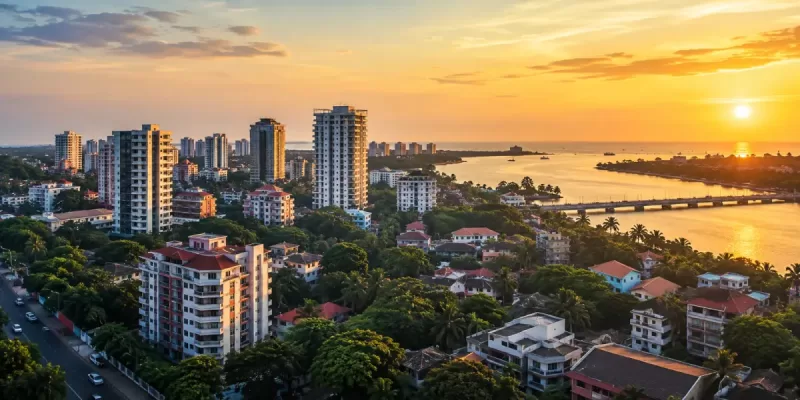
My cousin bought a 2 BHK flat in Bejai in 2019 for ₹52 lakhs. Last month, a similar unit in the same building was listed at ₹84 lakhs. He didn't do anything particularly clever. He just bought in Bejai when it was still considered slightly expensive for Mangalore.
That gap — ₹32 lakhs in five years, without lifting a finger — is the conversation that keeps coming up every time a group of Mangaloreans get together these days. And with property prices in the city moving faster than most people expected, the question I keep hearing is: have we already missed it, or is there still time?
I'm not a property agent. I'm not going to tell you to buy something. But I spent the last few weeks talking to people, looking at actual data, and trying to form a halfway honest opinion. Here's what I found.
What's Actually Happening to Prices
Let's start with real numbers, because this conversation deserves them.
According to current market data from 99acres, here's roughly where Mangalore's key neighbourhoods stand in early 2026:
- Bejai: ₹7,000/sq ft average — up 37.3% in three years, up 75% in ten years
- Kadri: ₹7,050/sq ft — steady, limited new supply, consistently strong demand
- Urwa: ₹6,600/sq ft — up 11.9% year-on-year
- Derebail: ₹5,950/sq ft — up 14.4% year-on-year, strong rental demand from students
- Kulshekar: ₹4,050/sq ft — mid-segment, emerging, decent long-term potential
- Surathkal: ₹3,750/sq ft — lower entry point, highest rental yield in the city at around 5.3%
- Ashok Nagar: ₹6,250/sq ft — up 25% in three years
For context: a 2 BHK in Bejai today will run you somewhere between ₹84 lakh and ₹1.1 crore. In Kulshekar, you can still find options under ₹65 lakhs. The range exists. But the window at the lower end of that range is narrowing.
Why Mangalore Is Moving Faster Than Expected
A few years ago, Mangalore was the sensible, affordable cousin of Bengaluru real estate. People bought here for retirement, for their parents, or because they wanted something "back home." Investment-grade buying — the kind where you're expecting real appreciation — was not the primary story.
That's changed, and it's changed because of a few things happening simultaneously.
Infrastructure is catching up fast. The Mangalore International Airport has expanded its routes and handles growing passenger traffic. NH-66 widening has made the coastal highway commute significantly smoother. The Smart City project has brought visible changes to roads, drainage, and public infrastructure in several wards. These aren't promises — they're things you can see if you drive around the city today.
Bengaluru fatigue is real. A segment of Bengaluru residents — particularly those with Mangalore roots — are actively reconsidering. The cost of living, the traffic, the apartment prices (₹12,000–18,000 per sq ft in decent Bengaluru neighbourhoods) make Mangalore look not just affordable, but genuinely attractive. Mangalore, at ₹7,000/sq ft in its best areas, offers a coastal lifestyle that Bengaluru simply cannot.
NRI investment is accelerating. The Tulu Nadu NRI community — particularly Gulf-based families — has always had a real estate relationship with Mangalore. But in recent years, that interest has become more investment-oriented rather than purely sentimental. Premium apartments, gated communities, and RERA-compliant projects are attracting NRI capital at a pace local builders weren't seeing three years ago.
The student-professional rental economy. Institutions like Kasturba Medical College, NITK Surathkal, and a growing number of IT companies employing over 15,000 professionals mean consistent rental demand. Surathkal's 5.3% rental yield — the highest in the city — is driven almost entirely by this NITK-adjacent demand. Derebail sees steady student rental absorption. This makes buy-to-rent a more viable strategy here than in most Tier 2 cities.
The Neighbourhoods Worth Paying Attention To
Bejai — Premium, Central, Proven
People half-jokingly call it the "Manhattan of Mangalore" — which is an exaggeration, but not an entirely unfair one. City Centre Mall, AJ Hospital, Forum Fiza Mall, and multiple schools within easy reach. Bejai is where Mangalore's upwardly mobile middle class lives, and it prices accordingly. At ₹7,000/sq ft with 37% appreciation over three years, it is no longer cheap. But it is the most liquid real estate market in the city — meaning it's the easiest to sell if you need to exit.
Kadri — Upscale, Limited, Reliable
Kadri is Bejai's quieter, leafier neighbour. Limited land, established neighbourhood, strong demand from families and NRIs. Projects like Udbhav Chinmaya (RERA-registered, 3 and 4 BHK at ₹1.37–1.8 crore) and Land Trade Altitude (ultra-premium, starting at ₹4.89 crore for 4 BHK) show you the full range of what Kadri offers today. The mid-segment is harder to find here, which is both the point and the constraint.
Derebail and Kottara — The Smart Mid-Range Bet
If Bejai and Kadri feel out of reach, Derebail deserves serious attention. At ₹5,950/sq ft with 14.4% year-on-year growth, it's genuinely affordable by Mangalore's current premium standards, has strong student rental demand, and sits close enough to the city centre to not feel remote. Kottara Chowki at ₹6,250/sq ft is in the same bracket.
Surathkal — For Rental Yield Seekers
The NITK factor makes Surathkal unique. At ₹3,750/sq ft, it has the lowest entry point among the named localities, but the highest rental yield in Mangalore at 5.3%. This is not a glamour investment — don't expect the appreciation story of Bejai. But for buy-to-rent buyers who want steady passive income, Surathkal makes more mathematical sense than most options.
Kulshekar — Emerging, Affordable, Patient Capital Required
The Kulshekar story is one for buyers who can wait. Currently at ₹4,050/sq ft, with proximity to the airport (15 minutes) and growing IT presence in the area. It's an emerging bet, not a proven one.
What Nobody Is Talking About Enough
There's a supply constraint issue in central Mangalore that is often understated.
In areas like Kadri and Bejai, there simply isn't much land left to build on. New supply has to go vertical — and given local building regulations and the costs involved, new launches in these areas are invariably premium. This means the mid-range inventory in established central areas is slowly disappearing. What replaces it is either high-end or on the city's outskirts.
This is the dynamic that people who bought in Bejai five years ago benefited from. The same dynamic, right now, is playing out in Derebail and Kulshekar.
The Honest Cautions
It wouldn't be fair to write this without the other side.
Mangalore's rental yields — outside of Surathkal — are modest. Bejai at 3.3%, Kadri even lower. If you're buying purely for rental income, the maths need careful examination against your loan EMI.
The city's IT sector, while growing, remains smaller than its potential. The much-discussed IT parks and the 2 million square feet IT SEZ have been in various stages of "coming soon" for a while. The pace of that employment growth will determine a lot about whether the 2030 version of Mangalore property is significantly more expensive than today's.
RERA compliance matters here more than people acknowledge. Always verify your project on Karnataka's RERA portal (rera.karnataka.gov.in) before committing. The builder landscape in Mangalore includes both reliable names and projects that have had delays and disputes.
And finally — coastal property comes with coastal risks. Flooding patterns, infrastructure stress during heavy monsoon, and long-term climate considerations around coastal land are not hypothetical. They are real factors that belong in any honest investment conversation.
So — Last Chance or Not?
Honestly? The "last chance" framing is a sales tactic, and I'm going to resist using it.
What I'll say instead is this: Mangalore in 2026 is not the Mangalore of 2019. The window for very low entry prices in central neighbourhoods has largely closed. Bejai at ₹7,000/sq ft is not cheap. Kadri never was.
But Derebail, Kulshekar, and Surathkal still offer entry points that will very likely look different in five years. And for NRIs or Bengaluru residents comparing ₹7,000/sq ft in Bejai against ₹15,000/sq ft in Whitefield — with all the lifestyle and cost-of-living advantages that Mangalore brings — the comparison still clearly favours the coast.
The market is not screaming. It's just moving, steadily, the way Mangalore tends to do most things. Whether that's your kind of investment is a question only you can answer.
If you're researching specific projects or neighbourhoods in Mangalore and want to cross-check before buying, drop me a note at rahul@mangalorediary.in. I'll share what I know and flag what I don't.
FAQ
Is Mangalore real estate a good investment in 2025-26?
Yes, with caveats. Established areas like Bejai and Kadri have seen 37–45% appreciation over five years and remain liquid markets. Emerging areas like Derebail and Kulshekar offer lower entry points with solid growth potential. Rental yields are modest in most central areas (2.5–3.3%) except Surathkal, which leads the city at 5.3% due to NITK proximity.
What is the current price per square foot in Bejai, Mangalore?
As of early 2026, average flat rates in Bejai are approximately ₹7,000 per sq ft, with the range running from ₹5,850 to ₹8,350 per sq ft depending on project quality and floor level. Bejai has seen 37.3% appreciation over the last three years.
Which area in Mangalore gives the best rental yield?
Surathkal offers the highest rental yield in Mangalore at approximately 5.3%, driven by student and faculty demand from NITK Surathkal. Kodailbail (3.6%) and Bejai (3.3%) follow.
Should NRIs invest in Mangalore property?
Mangalore is increasingly popular with Gulf-based NRIs. Compared to metro cities, it offers significantly lower prices, a familiar coastal lifestyle, good infrastructure, and RERA-compliant project options. Premium apartments in Kadri and Bejai are particularly in demand among NRI buyers.
What is the most affordable area to buy property in Mangalore?
Surathkal (₹3,750/sq ft), Kulshekar (₹4,050/sq ft), and Bajpe (₹900/sq ft) represent the most affordable property markets in Mangalore. Of these, Kulshekar offers the best combination of affordability and proximity to city infrastructure.
How do I verify a Mangalore real estate project before buying?
All RERA-registered projects in Karnataka can be verified at rera.karnataka.gov.in. Always check the RERA registration number before committing to any new apartment project in Mangalore.
Disclaimer
This article is intended for general informational purposes only and does not constitute financial, investment, or legal advice. The property prices, appreciation figures, and rental yield data mentioned in this article are sourced from third-party platforms including 99acres.com, OneCityProperty.com, and publicly available builder listings, and are accurate to the best of our knowledge as of May 2026. Real estate markets are dynamic — prices, availability, and market conditions can change without notice.
MangaloreDiary.in and the author, Rahul S, are not registered real estate agents, financial advisors, or legal consultants. Readers are strongly advised to conduct their own due diligence, consult a certified financial advisor or RERA-registered real estate professional, and independently verify all project details on the Karnataka RERA portal (rera.karnataka.gov.in) before making any property purchase or investment decision.
Any personal anecdotes or examples used in this article are for illustrative purposes only and do not guarantee similar outcomes for readers.




2 Comments
This is a very insightful article. Mangalore’s infrastructure is indeed growing rapidly, making it a prime spot for long-term investments.
Such events are vital for promoting local culture and tourism. Hope to see more of these in the coming months!
Leave a Comment